Three quarters of the Czech Internet already use AI
A new STEM survey says that almost three quarters of Czech internet users have experience with artificial intelligence. A big number. But the most interesting thing is what lies beneath it.

A new STEM survey says that almost three quarters of Czech internet users have experience with artificial intelligence. A big number. But it itself leads to two mistakes, and mainly hides three stories that are more interesting than the headline one: how fast it happened, how shallow we still use AI, and where we actually stand in Europe.
When I got the call from the newsroom last week saying we were going to talk about this issue in the news, the first thing I thought wasn't "wow, how fast." It was "okay, but let's be precise". Because the headline "three quarters of Czechs and Czechs have experience with AI"is only true until you add one word to it. And that word changes everything.
Almost three quarters. But three quarters of whom?
April survey of the STEM Analytical Institute, Trends series, collection 22-30. April 2026, 1,315 respondents, was conducted using the online survey method. This is important: his results apply to the online population, i.e. people who use the internet. Not for the entire adult population.
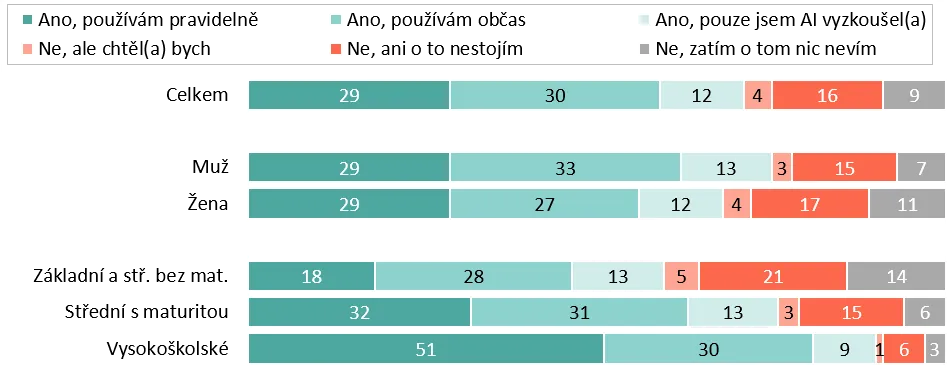
In this group, 59% of people use AI regularly or occasionally, and another 12% have at least tried it. In total, therefore, some experience with tools like ChatGPT, Claude or Copilot has roughly 71%, hence "almost three quarters". Another 4% say they would like to start but haven't gotten around to it yet.
Zkušenost s AI
71 %
českých uživatelů internetu AI používá nebo si ji aspoň vyzkoušelo.
Mladí do 29 let
92 %
pracuje s AI pravidelně nebo občas. U skupiny 60+ je to 35 %.
Vysokoškoláci
51 %
používá AI pravidelně. U lidí bez maturity je to 18 %.
The difference between men and women is small, with roughly three-quarters of both having experience. Education divides much more strongly: 51% of university students use AI regularly compared to 18% of people without a high school diploma. STEM analyst Jiří Táborský makes a provocative but factual comment about this: AI can be another factor in social stratification, because it will allow well-off households to escape from those less well-off even more.
Zdroj grafu: STEM, Trendy 04/2026.
A third or three quarters?
Here comes the trap I was talking about. STEM asked the same question last year too, so we have a comparison over time. And a few weeks before this year's wave, the Czech Statistical Office also published its figures. When you put them side by side, they look like a contradiction at first glance. They are not.
| Zdroj | Číslo | Co přesně měří |
|---|---|---|
| STEM, duben 2025 | 38 % | celá dospělá populace 18+, otázka „použil(a) jste někdy?“ |
| STEM, duben 2026 | ~71 % | uživatelé internetu, zkušenost nebo používání AI |
| ČSÚ / Eurostat, 2025 | 32 % | celá populace 16+, použití v posledních 3 měsících |
Between 2025 and 2026, STEM also changed the base, from the entire population to internet users, so 38 -> 71 cannot be taken as the same number. But the direction is unmistakable: rapid growth.
If you exclude from the calculation roughly 8% of people who have never used the Internet, according to the CZSO, that is about 680,000 people, the vast majority of whom are seniors, the numbers come close. STEM talks about those who are already online, CZSO about everyone. For television input, and indeed for any honest debate, the phrase "three quarters of Czech Internet users" is more accurate than "three quarters of Czechs". It looks like a detail. In fact, it's the difference between a claim that holds up and one that someone debunks in five minutes with another official number.
The novelty became a common tool within a year
Whichever number we take, the momentum is the same: sharp. Last April, STEM measured the experience of AI at 38% of people, then still for the entire adult population. This year we are at the mentioned three quarters of the online population. Even if the two numbers are not measured exactly the same, and it makes no sense to mechanically compare them as 38 -> 75, the direction is unmistakable: in a single year, the reach roughly doubled.
At the same time, companies give the cleanest series over time. Here, the CZSO measures the same three years in a row:
Firmy 10+ zaměstnanců
2023
~6 %
Firmy 10+ zaměstnanců
2024
11 %
Firmy 10+ zaměstnanců
2025
17 %+
Why the jump? It didn't happen in a vacuum. AI jumped on ready-made habits. More than 80% of people in the Czech Republic use the Internet every day, 78% manage mobile banking, and 68% shop online. The entry barrier was low. Three technological things have been added to this: models are cheaper and faster, more accessible and most importantly invisible: you don't need to look for AI in a special application today, it is waiting for you in the search engine, in the office suite, in the phone from Apple and Samsung, and from May 2026 in the Newsfeed of Seznam.
Tahle věta drží
První vlna byla tažená zvědavostí. Druhá je tažená užitečností. A užitečnost bývá trvalejší než zvědavost.
Hard data on productivity shows that it's no longer just curiosity: an NBER study of more than five thousand customer support workers found an average increase in performance of 14%, and even 34% for less experienced people. Once a person finds one particular scenario where AI saves them time, they return to it. Therefore, I expect that there will be more regular users. Just not as wildly anymore: we hit a natural ceiling. Roughly a third of people, and almost half of people over 60, don't consciously care about AI, and the most common reason is not fear, but simple "I don't need it yet".
Where they notice the Czech Republic
This is the part that is usually not written in Czech articles, and yet it is the most informative. Eurostat last year, in 2025, for the first time ever measured the use of generative AI across Europe using a uniform methodology. On average, a third of people (32.7%) between the ages of 16 and 74 used it in EU countries. With 32%, the Czech Republic is practically exactly on the European average, neither ahead nor behind.
In front are the Nordics: Norway 56%, Denmark 48%, Estonia and Malta 47%, Finland 46%. Behind Romania 18%, Italy 20%, Bulgaria and Poland 23%. Of the large economies, Germany (32%) and Italy are below the average, while Spain (38%) and France (37%) are above it. So in the total population we are the European average.
But now the interesting thing. When Eurostat looks only at young people aged 16-24, the Czech Republic jumps out among the absolute European leaders:
| Země / skupina | Použití generativní AI, 16-24 let, 2025 |
|---|---|
| Řecko | 83,5 % |
| Estonsko | 82,8 % |
| Česko | 78,5 % |
| Průměr EU | 63,8 % |
| Polsko | 49,3 % |
That, in my opinion, is the most important finding of this whole wave of data. Among adults, we are the European average. Among young people, we are third best in the entire European Union. The generation now sitting in schools will enter the job market with AI as a matter of course and take it with them. In other words: the difference between 32% in the population and 78.5% in the youth is not a state, it is a prediction.
And I don't think it's a coincidence or just the collapse of technology. The fact that Czech schoolchildren are among the top in Europe is also due to a good amount of education. I myself visit dozens of schools every year with lectures about AI, and initiatives such as AI for children and other associations do the same thing: they try to teach children and their teachers to work with AI smartly, critically and without fear. These numbers are also their merit.
Fast and wide. But still pretty shallow
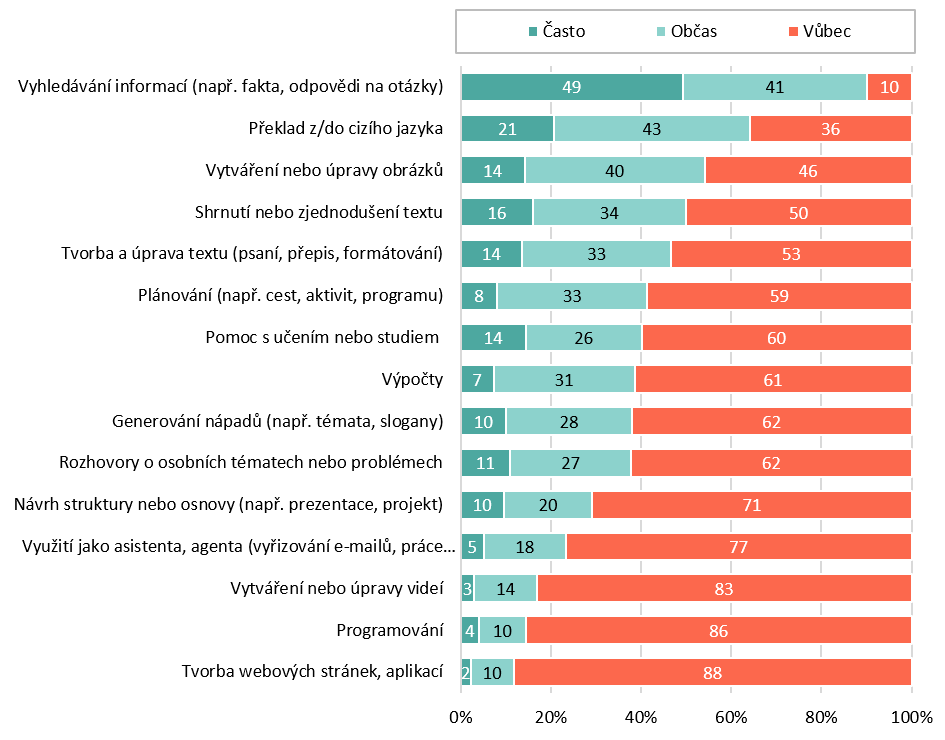
Here it pays to be honest with yourself as well as the field. Just because three-quarters of people have "tried" AI doesn't mean they're using it deeply. STEM asked what exactly AI is for humans, and the answer is sobering:
Zdroj grafu: STEM, Trendy 04/2026.
It's still primarily a smart search engine and translator. 90% of users use information search at least occasionally, 49% often. Translation, image creation and text summarization are high. Advanced use, agent AI or programming, remains the domain of a small group.
This follows up nicely on the big study we wrote about here last fall, when OpenAI first released data on how people actually use ChatGPT. A couple of things came out of it that pleased me: that most text work isn't about AI writing for us, but helping us improve our own text. And as we gradually move from “do” mode to “ask” mode, we treat AI more as a smart advisor than as a servant. Czech data confirm this picture.
Z našeho blogu
Jak lidé doopravdy používají ChatGPT?
Rozbor studie o tom, že lidé používají AI častěji jako poradce a editor než jako automat na hotové texty.
Fear of work overtakes reality
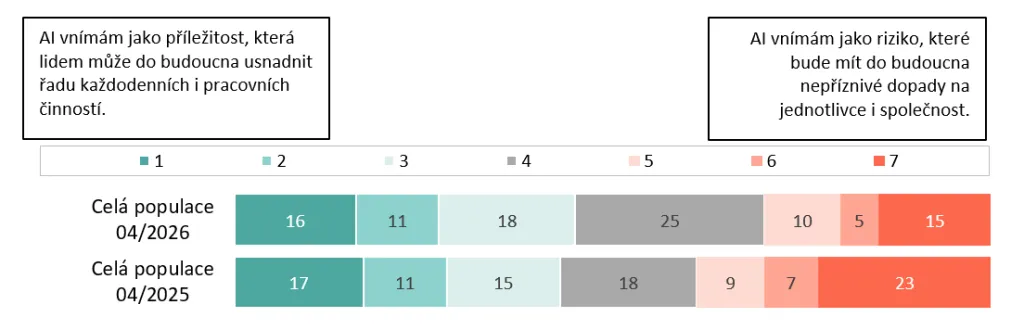
Czechs perceive AI more as an opportunity (45%) than as a threat (30%), the rest are neutral. And the development is interesting: people who last year had a negative attitude towards AI have moved towards the middle this year, while the positive ones have remained their own. The fear is alleviated precisely where humans have started working with AI.
Zdroj grafu: STEM, Trendy 04/2026.
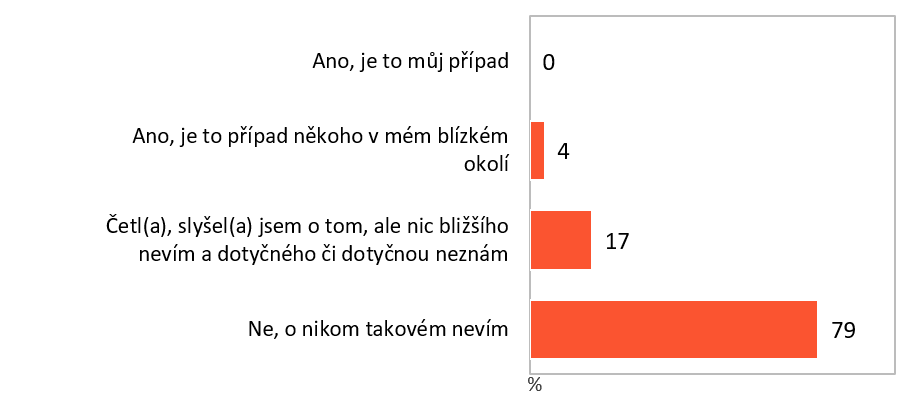
The sharpest contradiction is at work. Half of people worry that AI will cause someone close to them to lose their job. A quarter have a personal concern about their own profession. But when STEM asked about the reality, the picture is completely different:
Zdroj grafu: STEM, Trendy 04/2026.
This does not mean that the effects on the labor market will not come. It means that in the Czech Republic it is still a topic of concern and expectation, fueled by the media image, rather than a mass everyday experience.
By the way, what Czechs fear most is not so much job loss. These are things around information and security: that it will no longer be possible to tell what is created by man and what by machine, the rise of cyber-attacks and the misuse of AI by authoritarian regimes. And that brings me to the last and in my opinion the most important part.
When to trust AI and when not to
People often do not trust the correctness of AI outputs. And it's so good, that caution is not backwardness, it's common sense. But it pays to know why, because then you can turn it into a simple rule.
A great language model does not think like a human, it thinks in its own way. At the lowest level, they try to guess the next word, token, after the previous one, but above that emerge emergent phenomena that have long outgrown the simplified description. So far from being "just a statistic", it is also not a machine that understands the world as we do. And it is precisely in that gap that the problem arises: the model can produce a stylistically perfect, confident-sounding and yet completely fictional answer. This phenomenon is called hallucination.
OpenAI itself describes it as a believable but false claim, admitting that current ways of evaluating models often reward guesswork rather than an honest "I don't know". Anthropic, on the other hand, directly advises to take outputs with a grain of salt, especially for current topics, and to always verify cited sources.
I imagine it as a brilliant fantasist with enormous self-confidence. Or as a junior student who has graduated from dozens of universities and read almost everything, but still lacks contact with ordinary human reality. He can do so much, but he needs someone to be the adult in the room.
This is the basis of the rule that I say in lectures and at home:
Bezpečnější zóna
AI je skvělá tam, kde pracuje s materiálem, který jí dám: shrne můj text, přeloží dokument, upraví formulaci, připraví osnovu.
Zapnout ostražitost
Když AI sama tvrdí fakta o světě: aktuální zprávy, statistiky, citace, jména, medicína, právo, finance. Bez zdroje je to návrh, ne závěr.
And the direct ratio applies: the more the information has an impact on your health, money or reputation, the less one answer from the chatbot is enough. The fluidity of the text and the confident tone of the machine are never proof of the truth.
This leads to the most important thing for me, which I repeat over and over again: let's not let artificial intelligence think for us. The worst thing we can do is turn off our own head and blindly copy what the model generates. It is much better to use it in the Socratic method, as a debate partner who asks you questions and forces you to think things through.
And if you need something more reliable? Turn on the internet search model, support it with verified sources, it's called RAG, the model then speaks over your data, not from its memory, and think about what the model is actually suitable for. For some things, the small and fast one is enough, for more complex considerations, you reach for the strongest one. It's all about critical thinking, not blind faith.
Not a toy, not a threat, but a tool
This data fits right into what we at Alpha Industries have been striving for since 2018: AI with a human face. Not technology for enthusiasts, but a tool that actually helps people and that they know how to handle. When we make DigiHavla for schoolsor build an AI Studio, it's always the same thing: that AI is not a black box, but a partner that you understand and can check.
That's why I'm most pleased about the STEM and Eurostat numbers, not the size, but the shift in heads. People who were afraid last year have moved to the center this year. This will not become regulation or scaremongering. This will happen as the human tries out the AI, finds what it's good for, and finds out where it's at.
Exactly this digital and information literacy is the whole game. AI is no longer a toy for a few people in the Czech Republic, it is a common tool. And further growth will not come from enthusiasts, it will come from people who discover one particular time saver in it. For facts and quotes only, please remember: there AI is the beginning of the work, not the end.
And at the very end, the most important thing I say in every lecture: don't be afraid to experiment. Nurture your childlike curiosity, the same one that led 81% of people to try AI in the first place. Fear of AI will not be dispelled by lectures or instructions, but only by touching it, playing with it and finding out for yourself what it can do and where its limits are. Curiosity is by far the best way to really learn it. And at the same time, the best defense against being afraid of her.
Resources and further reading
- STEM: Three quarters of Czech Internet users have experience with artificial intelligence(Trends 04/2026, CAWI, n = 1,315).
- Czech Statistical Office: Artificial intelligence is used by a third of the population(Use of ICT in households and between individuals, 2025).
- Eurostat: 32.7% of EU people used generative AI tools in 2025and 64% of 16-24-year-olds used AI in 2025.
- Alpha Industries: How do people really use ChatGPT?.
- Stanford HAI: AI Index Report; OpenAI and Anthropic: documentation on hallucinations and source verification; NIST: AI Risk Management Framework.