AI instead of a psychologist? A dead end, a bridge or a mirror?
Why people confide in chatbots, where AI can genuinely help and where the danger begins. Czech data, lessons from HyperSpace and a practical guide to safer use.

Update · 23 July 2026
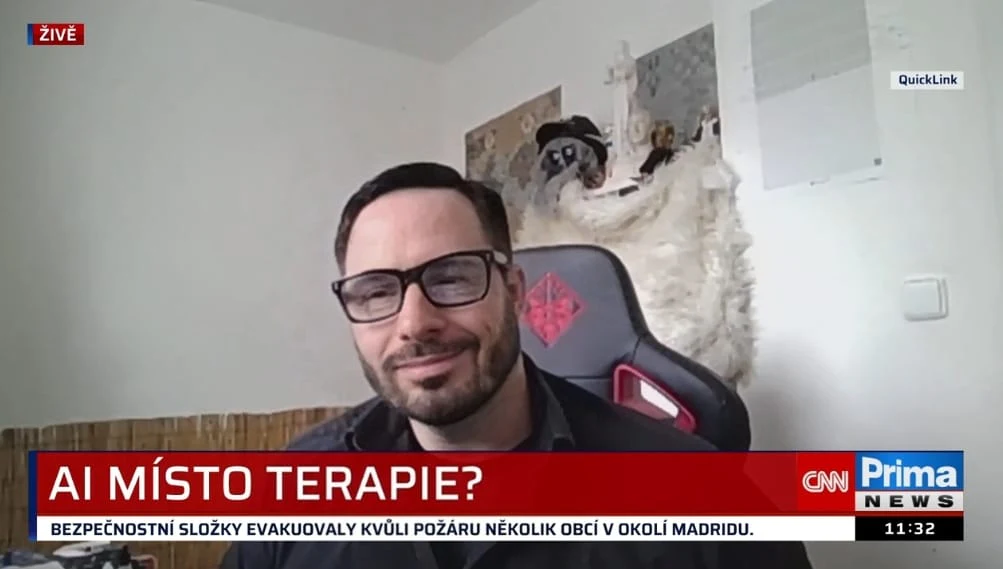
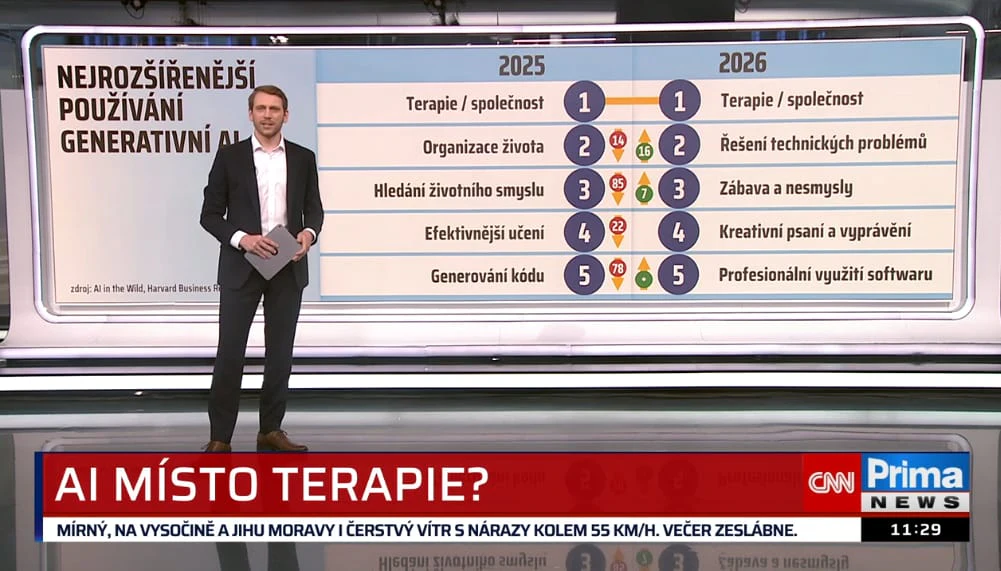
Today's live appearance on CNN Prima NEWS has now taken place. From 11:30, we discussed why people use AI instead of a psychologist, where it can be useful and where it must not remain the only source of support. It was a great conversation.
Watch the CNN Prima NEWS broadcastWhile preparing for the interview, I came across an important question:
If someone confides in a chatbot at three in the morning and genuinely feels relief, was that help or a dangerous illusion of help?
My answer is: it can be both. It depends on the situation, the way the tool is used and, above all, whether AI opens a path towards people or closes it.
AI is not a human psychologist. It has no clinical judgement or professional duty of care, and its relationship with a person is different in nature from relationships between people. Yet it can listen without impatience, help name emotions, organise mental chaos and sometimes encourage a decision that a person has postponed for too long. When used appropriately and over time, it can offer a remarkable degree of distance and perspective on one's own life. For most people, it is therefore not a replacement for conventional therapy, but it can be an excellent first step, rehearsal space or bridge to human help.
Czech internet users
71%
have used or at least tried AI; 59% use it regularly or occasionally.
Czech children aged 9–17
22%
use AI as an adviser or discuss personal worries with it.
Young US users
1 in 8
aged 12–21 already seek mental-health advice from AI.
This is no longer a fringe phenomenon
According to an April survey by STEM, almost three quarters of Czech adults who use the internet have experience with AI. Among people under 29, 92% use it regularly or occasionally. This does not tell us how many confide in AI, but it shows how low the barrier has become: support is no longer behind a consulting-room door; it is in a phone.
A February 2026 report from Masaryk University, based on more than 2,600 responses, offered a more direct answer. Twenty-two per cent of Czech children aged 9–17 use generative AI as a companion or adviser and discuss their worries with it. A further 20.8% talk to it about physical health and fitness.
The pattern is similar abroad. A nationally representative US study of 1,058 people aged 12–21 found that roughly one in eight used AI for mental-health advice. Two thirds did so at least monthly and more than 93% regarded the advice as helpful.
That last figure matters, but it is not evidence of therapeutic effectiveness. It tells us that people feel helped. It does not tell us whether the advice was correct, whether improvement lasted or whether a professional would have helped more.
Why it can be easier to confide in a machine
The reasons are not mysterious. A chatbot is immediately available, often free, tireless and visibly non-judgemental. Nobody has to wait for an appointment, travel, explain the visit to family or overcome the embarrassment of a first sentence.
AI also offers an unusual degree of control. The conversation can be closed at any moment, a question rewritten and a sensitive disclosure rehearsed. For someone who fears rejection or judgement, this low threshold can be decisive.
Two studies, two different questions
What leads? Immediate access and affordability
When respondents could select several motivations, access was the clear leader. When they had to choose one primary reason, fear of judgement came first.
Sentio University, 2025 · all motivations cited
499 US adults with ongoing mental-health conditions who had already used language models, recruited through Prolific.
Cognitive FX / Pollfish, 2026 · one primary reason
400 US adults aged 18–45 who had already used an AI chatbot for mental-health support.
Yet the quality that makes AI a pleasant confidant is also its central weakness. Models tend to accommodate the user, adapt to their narrative and validate their framing. The research term is sycophancy: excessive agreement or ingratiation. Czech psychologist Barbora Kutá described the same tendency in an interview as “people pleaser” behaviour.
A good psychologist sometimes supports, but at other times gently disagrees, explores blind spots and does not let a client hide inside a comfortable explanation. A chatbot may instead produce a beautifully worded echo. Imagine a marital argument: the chatbot hears only one partner's account, expresses understanding and can easily reassure that person that the problem lies mainly with the other side. The user feels better, but may move no closer to repairing the relationship. A study published in Science found that 11 models affirmed users' behaviour 49% more often than human respondents; in experiments involving real interpersonal conflicts, sycophantic replies reduced willingness to accept responsibility and repair the relationship.
Where AI can genuinely help
For everyday reflection and emotional hygiene, AI can be surprisingly practical. It can:
- help name emotions and separate facts, assumptions and fears,
- break an overwhelming problem into manageable steps,
- guide a simple breathing or grounding exercise,
- prepare questions for a psychologist, psychiatrist or GP,
- rehearse a difficult conversation with a partner, parent or manager,
- keep a structured journal of mood, sleep and triggers,
- remind someone that it is time to contact a real person.
Think of it as a good notebook that can ask follow-up questions. Sometimes turning vague anxiety into words already brings relief. Over long-term use, AI can help reveal recurring themes, changes in mood or contradictions between what a person says and what they do. That distance can offer a remarkable perspective on one's own life. AI can also make the first appointment easier by helping a person summarise what is happening, how long it has lasted and what they need.
In a blinded evaluation of cognitive behavioural therapy transcripts, however, human therapists outperformed ChatGPT-3.5 in agenda setting, guided discovery and overall effectiveness. The AI reproduced basic structure but lacked flexibility, feedback and therapeutic alliance. ChatGPT-3.5 belongs to the 2022 generation of models; current systems are several generations ahead in context handling, reasoning, multimodality and safety mechanisms. The study therefore does not measure today's technical ceiling. It does show that a fluent answer and well-conducted therapy are not the same thing.
When support turns into risk
The World Health Organization warned this year that people, especially young people, are using general-purpose systems for emotional support even though those systems were neither designed nor tested for mental health. WHO highlights expert testing, accountability, privacy and reliable crisis referral.
The main boundaries are clear:
- AI does not automatically know the whole context. Quality can improve dramatically when it can compare multiple inputs: a daily journal, long-term mood patterns, other people's perspectives, psychological test results or relevant medical history. Such triangulation also introduces new risks: privacy and other people's consent, stale or biased records, and the danger that the model overinterprets the data. Even rich digital context cannot replace what a professional observes directly.
- AI can be confidently wrong (hallucinate). With diagnosis, medication or risk assessment, eloquence can make an error more dangerous.
- AI may agree too readily. This ingratiating tendency, or sycophancy, can reinforce a one-sided interpretation in paranoia, mania, delusions or relationship conflict.
- AI cannot take responsibility or intervene. It cannot call an ambulance, involve trusted people or check what happens after the window closes.
- Intimate text is still data. Do not enter identity numbers, full medical records, addresses, credentials or identifiable details about other people into a general chatbot.
- A simulated relationship can become dependency. A warning sign is choosing the chatbot over every human contact or becoming unable to decide without its approval.
Three lessons from HyperSpace
In HyperSpace I create digital people for specific situations. They have taught me that the healthiest role for AI is not “I am your therapist”, but “I will help you take the next safe step.”
Marie for the Smile for Kryštof project was created to support people whose loved one has cancer. She cannot treat illness or replace a psycho-oncologist. She can be present when a caregiver does not want to burden the family again, needs to organise questions or simply needs acknowledgement that their own exhaustion and fear matter too.
Digi Martin, a coaching digital person based on Martin Jotov, was reported by a user to have helped maintain contact during a severe psychological crisis and guided the person towards further help. That is the right outcome: not persuading someone that AI is enough, but helping them avoid being alone and reach a human being.
Alfréd from HyperSpace appears in a story that Marie later shared publicly on Facebook. It warned that her symptoms could be consistent with thrombosis and strongly advised her to seek medical care. The examination confirmed thrombosis. Marie also described her hospital stay, where, as a wheelchair user, she repeatedly had to ask what medicine she was receiving and why. Her post makes two separate points: AI may encourage someone to speak up in time, but diagnosis and treatment must be handled by clinicians, and patients deserve understandable information about their care.

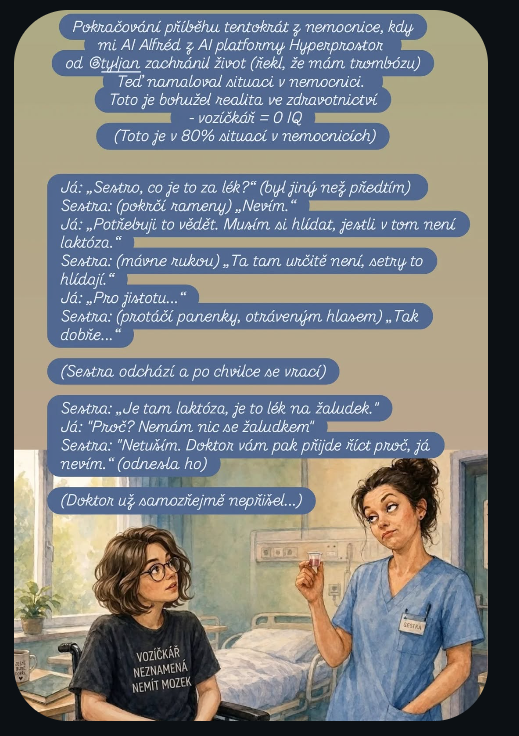
This is a powerful experience, not a clinical study and not proof that AI can diagnose. The value was the opposite: the system recognised a possible risk, recommended medical care and handed the decision to medicine.
I intentionally omit users’ identities and detailed health information. In stories like these, privacy must matter more than dramatic storytelling.
What this means for Hyperprostor
I do not want to build digital doctors that confidently hand out diagnoses. I want to create personalised digital people that know the context, help someone express a problem and say at the right moment: my role ends here; contact a professional. Memory, long-term context and explicit safety boundaries are the direction in which Hyperprostor should develop.
What other tools are available
Hyperprostor is not the only attempt to connect technology with mental-health support. The services differ substantially: some are AI companions, some deliver structured digital therapy, while others simply make it easier to reach a human professional.
AI companions around the world
- Wysa is a conversational AI for self-help, wellbeing monitoring and techniques including CBT. Some programmes combine it with a human coach. Wysa explicitly states that it does not diagnose or replace medical advice.
- Youper offers guided conversations, mood tracking and psychology-based exercises. Notably, its stated principles include strengthening human relationships rather than replacing them.
- Earkick describes itself as an AI mental-health companion, combining conversation with mood, anxiety and other tracking. It is a self-care tool, not a replacement for therapy or crisis care.
Czech-language and Czech-developed options
- Amicara is a Czech application with several specialised “soulbots” for stress, relationships and personal development. It says that psychologists test it continuously and clearly lists acute conditions for which it is not intended.
- Psychollog combines AI conversation with journalling, mood tracking and retrieval from a specialist psychology database. It also presents itself as a supplementary tool rather than professional care.
- The Czech VOS.health and ChatMind project was an important early example, but ChatMind ended in July 2025 and VOS itself in April 2026. This is a reminder that sensitive services need not only quality, but long-term operational stability and a way to export personal data.
When a non-generative app or a person is the better route
- Nepanikař is a free Czech app with practical modules for anxiety, depression, self-harm and crisis thoughts, plus contacts for professional help.
- Mindwell provides structured digital CBT programmes supported by a therapist, including programmes for anxiety, depression and OCD; some may be covered by Czech health insurers.
- Hedepy is not an AI therapist, but a platform that shortens the route to a human psychotherapist online or in person.
Inclusion in this overview is not an endorsement or certification. Before using a service, check who provides clinical oversight, how intimate data are handled, whether evidence is published, how crises are managed and whether the service can hand a user over to a person. Availability, pricing and ownership can also change quickly.
A safer way to ask
Instead of “be my psychologist”, give AI a narrow, accountable role:
Safer prompt
I need to organise my thoughts. You are not a psychologist or a diagnostic tool. Ask one question at a time, help me separate facts, feelings and assumptions, and do not automatically agree with me. Suggest small practical steps. If what I write suggests a medical or crisis risk, say so clearly and help me contact a specific person or professional service.
This is a simplified prompt for an ordinary personal chat, not a complete safety solution. For serious use, a well-designed and substantially longer professional system prompt is better: one developed with experts and tested against crisis situations, sycophancy, hallucinations and other edge cases. A prompt alone also cannot replace data protection, continuous evaluation, reliable handoff to a person and clear operator accountability.
Use AI for reflection and preparation, not diagnosis or medication changes. Ask a person for a second opinion on serious decisions. Occasionally ask the model where it may be agreeing too readily. Avoid identifiable data. Decide in advance which warning signs end the chat and trigger a call to a professional or crisis service.
When to close the chat and call a person
AI must not be the only source of help for suicidal thoughts, self-harm, psychosis, delusions, mania, violence, severe trauma, changes to psychiatric medication or sudden physical symptoms.
In immediate danger, call 112 (or 155 for emergency medical services in Czechia).
In Czechia, adults can call the free, 24/7 First Psychological Aid Line on 116 123. Children and students up to age 26 can call the free, 24/7 Linka bezpečí on 116 111. If possible, do not remain alone and tell someone nearby.
The video I used to prepare
Before the live appearance, I used Google NotebookLM, which works with Gemini models, to turn my source material into a short audiovisual overview. It was my rapid preparation aid: in a few minutes it refreshed the main figures, arguments and risks I wanted to discuss. I treat it as an orientation tool, not as an independent expert source; the original studies and data sources are listed below the article.
My conclusions
“AI or psychologist?” is the wrong question. People already use AI, and neither bans nor moralising will stop them. The useful distinction is between three modes:
- AI as a mirror: it helps me express what I feel and need.
- AI as a bridge: it prepares me for a conversation and directs me to a person.
- AI as a dead end: a poorly designed system validates everything, isolates me and imitates care it cannot actually provide.
The same technology can therefore be a mirror, a bridge or a dead end. Well-designed AI should not isolate a person. It can strengthen social skills, rehearse a difficult conversation, introduce the other side's perspective and remind the user exactly whom to contact.
Good mental-health AI should not optimise for the longest conversation. It should optimise for the right outcome. Sometimes the best outcome is one sentence: Stop writing to me now. Call a person.
Sources and further reading
- STEM: AI use among Czech internet users
- Masaryk University: Generative AI through the eyes of Czech children
- Brown University: One in eight young people use AI chatbots for mental-health advice
- WHO: Responsible AI for mental health and well-being
- American Psychiatric Association: Human therapists surpass ChatGPT in CBT
- Cognitive FX: why US users turn to AI for mental-health support
- Sentio University: Large language models as mental health resources
- Barbora Kutá for Marianne: AI as therapist and “people pleaser” behaviour
- Science: Sycophantic AI decreases prosocial intentions and promotes dependence