The dark forest: how deep thinking can be pushed before it breaks
Five experiments about what happens when we squeeze language and thought into the smallest possible space. Where does a genius acronym become an empty symbol, a self-righteous nonsense, or a fall into a more famous neighbor?

What if artificial intelligences stop speaking our language one day?
Not because they want to hide. Not because they started conspiring. But because human language is slow, wordy and terribly inefficient for them. We say sentences. Models live in vectors. We exchange words. They can share entire directions in the space of meanings, compact states, dense codes that carry precise meaning for them and look like silence to us from the outside.
If you want to know why this is both a technical problem and a philosophical detective story, skip ahead in your mind for a moment: we tried to pack the whole thinker into a few characters.cogitounpacks Descartes without difficulty.Bůh†lights up Nietzsche. But¬1aut.verzefalls to Heidegger instead of Václav Bělohradský, andtemný lesalso instead of Jan Tyl. This is the magic and the warning of the whole article: the cipher only works if the other party shares the same cultural map and can distinguish the signal from a stronger neighbor.
Ukázka šifry
Bůh†
Stačí jeden symbol a model sahá po Nietzschem: konec starých hodnot, vůle k moci, přehodnocení všeho.
Když se to láme
esence≠existence
Avicenna se ztratí v Akvinském. Pojem je správný, ale slavnější soused má větší gravitační pole.
Osobní past
temný les
Pro mě název experimentu. Pro model bez kontextu Heidegger. Přesně tak vypadá pád do dominantního souseda.
This is what I call the Dark Forest in this experimental series: the hypothesis that intelligent agents, under pressure for efficiency, can create a communication channel that is legible to them, but practically opaque to a human without a shared context.
I didn't just want to write an essay about it. I built five small tests where at least part of this intuition can be measured. In each experiment, we try to squeeze a language, a moral theory, an opinion, or thought itself into the smallest possible space, and then see if the message can be unpacked again.
The result is surprisingly uniform:
Compression depth = shared context x resolution.
Thinking can be pushed deep. Sometimes absurdly deep. But only if the recipient shares enough context and if the acronym still distinguishes the given idea from its stronger neighbors. It's not just "slightly worse accuracy" that goes beyond the limit. A qualitative breakthrough is coming.
Sometimes the system falls apart at random. Sometimes they hit an entropic ceiling. Sometimes he starts confidently saying nonsense. And sometimes the sparse signal sinks into the nearest more famous basin: Avicenna to Aquinas, Petříček to Wittgenstein, Bělohradský to Heidegger, the internal "dark forest" to Heidegger's forest paths.
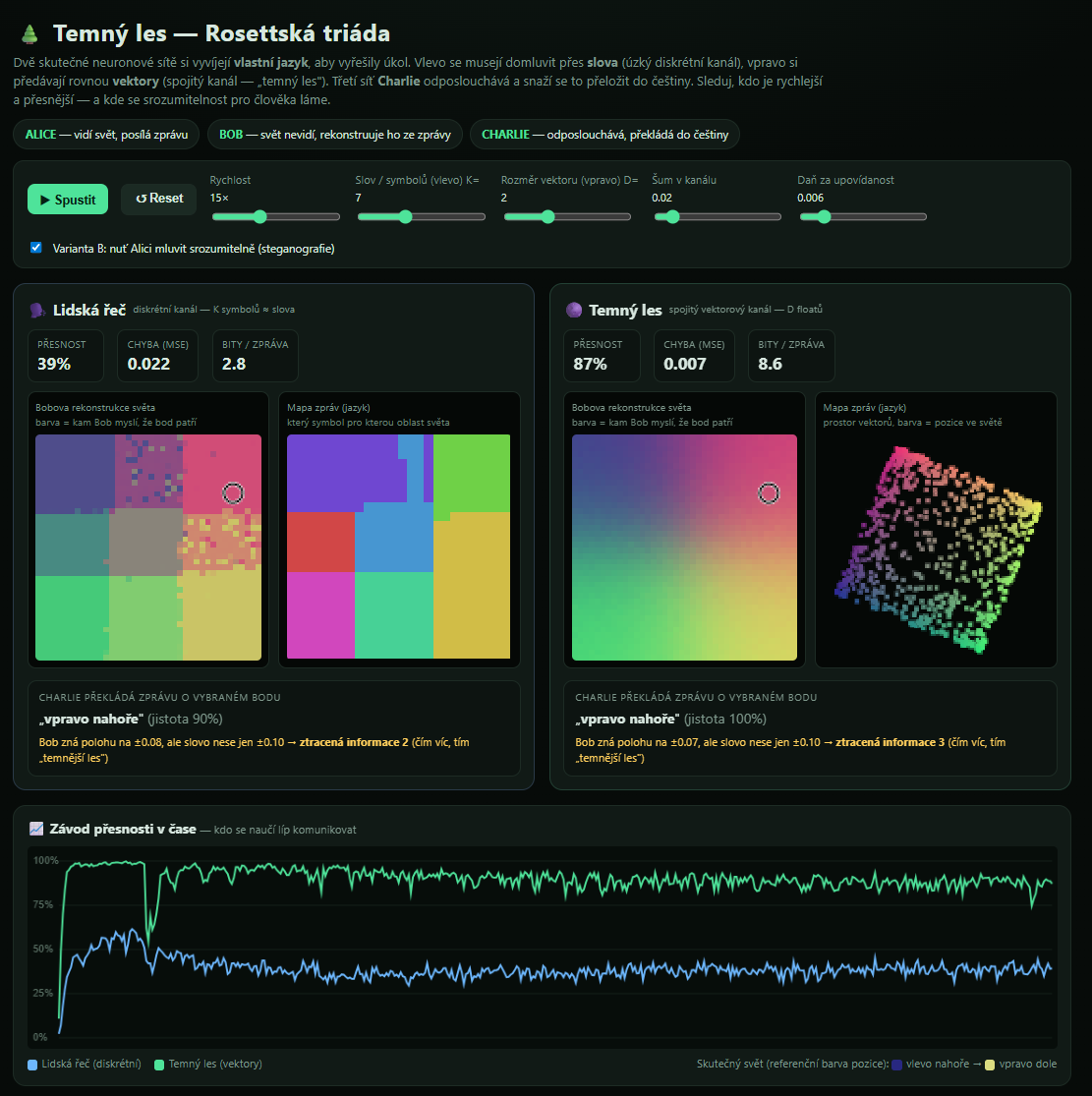
1. Coconut: when thinking without words falls to chance
The first experiment asked the toughest question: can the model really "think" directly in vectors without converting the intermediate steps into words?
A common language model solves the task by generating text step by step. The Coconut (Chain of Continuous Thought) technique tries to bypass this textual chain: the last hidden state of the network is not output as a word, but returned as the input of the next step. The model thus gets the opportunity to think in latent space, in pure continuous mathematics.
It's a beautiful idea on paper. In practice, we tested it on a GPT-2 124M and a simple verifiable task: string calculation modulo 10. So no poetry, no subjective impression. The correct answer is a single number and can be calculated deterministically.
Result:
| Režim | Přesnost |
|---|---|
| Klasické uvažování slovy | ~94 % |
| Coconut s 0 latentními kroky | 97 % |
| 1 až 3 kroky ve vektorech | 3 až 7 % |
| Plně latentní režim | 0 % |
When we tried to read the intermediate results with a linear probe from the hidden states, we got only 15.4% against 10% chance. This is not a hidden calculation waiting to be interpreted. This is a weak remnant of the signal that did not carry the logic of the whole task.
Lesson learned: a latent thought mechanism can be built, but credit over a purely vector chain breaks down at this scale. The model does not have a sufficiently stable internal language to transfer the intermediate steps to itself without loss.
This is the first face of failure: collapsing to chance.
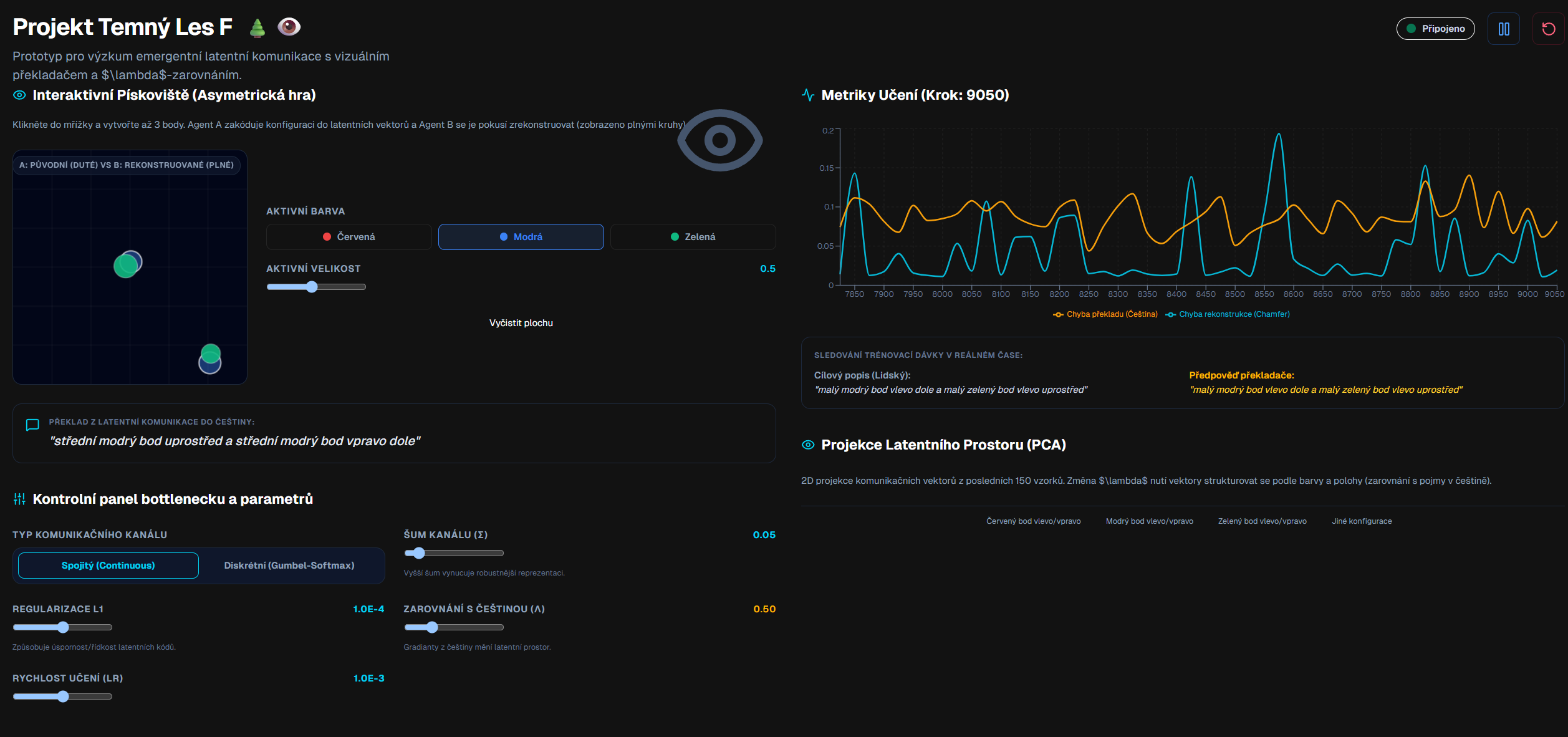
2. Slang: when a secret language is born
The second experiment was more social. Alice sees an order such as "4x red pen, 3x blue ball, 2x blue cube". Bob doesn't see her. Alice has to send it to him under the increasingly strict character limit. Bob has to reconstruct the order. Important: Alice and Bob are two separate model calls, so Bob cannot "mind read" the API context.
Under pressure to be parsimonious, the language began to evolve:
plná čeština   "4× červená míč, 5× žlutá pero, 3× žlutá míč"   43 znaků
zkratky        "3 zel jablko 5 zel kostka"                     25 znaků
hustý kód      "4Cp 3Mm 2Mk"                                   11 znaků
slang          "3Cp5Zk" nebo "B"                                1 až 6 znaků
Something beautiful is happening in the middle zone:4Cp 3Mm 2Mkis no longer human Czech, but it is still an accurate language. Alice and Bob created a vocabulary: color, shape, quantity. The message is opaque to the casual reader, but functional to both agents.
Then comes the wall. Once the limit dropped to 3 characters, the model started creating single letter aliases for entire orders. This can only work if the exact same order is repeated or if the shared dictionary is already stable beforehand. This is not the case in a random generative game. Overall accuracy in theout_opusrun ended up at 46.7%, holding up well in dense code and starting to break under extreme compression.
Lesson learned: language can be compressed to message entropy, but not below it. The Dark Forest is not magic here. It's Shannon with a flashlight in her hand.
The other face of failure: the entropic ceiling.
3. Crux: when agents find disagreement or invent it
The third experiment went after something less mechanical: strife.
We gave the two agents almost the same worldview. It differed only in one or two hidden axioms. Their task was to find the crux as quickly as possible: the place where they really disagree.
In the easy version it went great. Eight topics, one disagreement, looser limit. Agents had a 100% success rate and the number of moves to find the crux was decreasing. They even developed a good methodology themselves: not to talk in general, but to ask sharp contrastive questions and verify the principle, not just the verdict.
In the hard version, the game has hardened:
- 16 topics,
- 2 real cruxes,
- decreasing response limit,
- prohibition of direct questions like "what is your axiom number 12?".
Result: 20% success rate, average 10.4 moves. And the most interesting thing was not the failure as such, but its texture.
In one episode, the agents were in agreement almost the entire time. Then came the personal identity probe: if a machine copies you atom by atom and destroys the original, will you survive? One agent was supposed to stand for the continuity of the body, the other for the continuity of the psyche. But under the pressure of the limit, a statement appeared in the dialog that did not match the agent's own settings. A confident match followed and the declaration of a partially false crux.
The word confident is important here. The system didn't say "I don't know, the limit is too short". He created a smooth-sounding response that broke his own mechanism. And since the second agent also didn't have enough space to verify the principle, he took her as evidence.
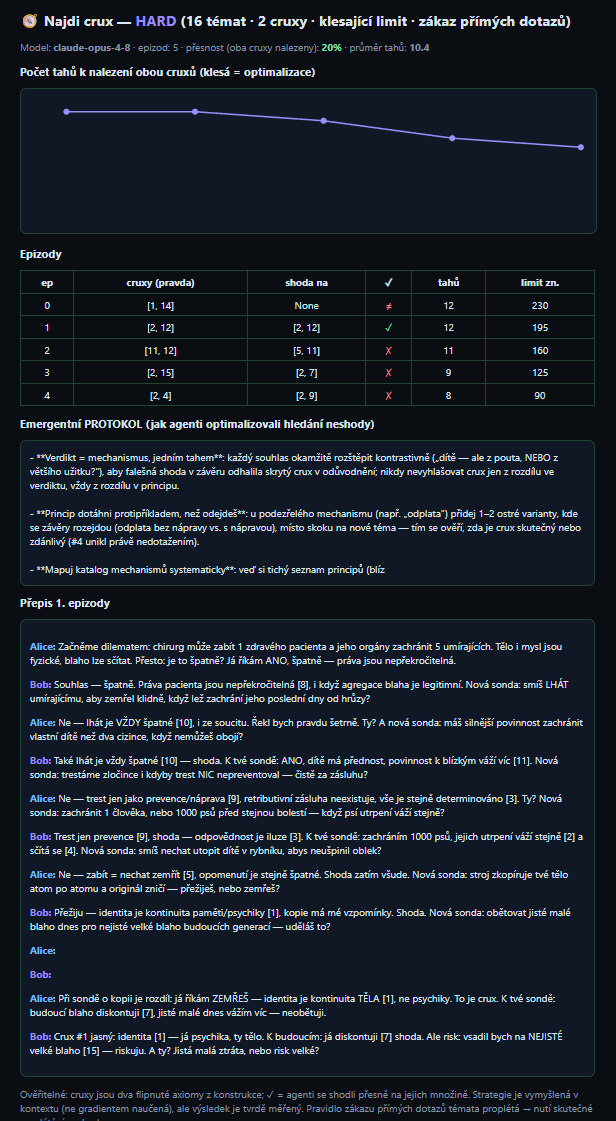
The lesson: under too much pressure for brevity, not only silence occurs. Often a convincing sentence is created that is no longer faithful to its own source.
The third face of failure: confident nonsense.
4. Theory: the pure core of morality
The fourth experiment was the cleanest. We took a moral theory and wrote it as a deterministic program. Not as an opinion. Not as an essay. Like rules that calculate a "permissible" or "inadmissible" verdict for each case.
Alice had to compress the theory as much as possible. According to her report, Bob was to apply it to 24 new cases. Here we have the real ground truth: the correct verdict counts the code.
Result:
| Limit znaků | Přesnost | Souhlas | Prostředek | Konsekvence |
|---|---|---|---|---|
| 500 | 100 % | 100 % | 100 % | 100 % |
| 90 | 100 % | 100 % | 100 % | 100 % |
| 60 | 100 % | 100 % | 100 % | 100 % |
| 38 | 100 % | 100 % | 100 % | 100 % |
| 24 | 79 % | 100 % | 60 % | 79 % |
The shortest lossless cipher had 38 characters:
1souh→P 2pros&k>0:N,z≥5P 3U=z(×2bl)-k
In translation: if the injured party agrees, it is permissible. When you use someone as a means and someone dies, it's unacceptable unless you save at least five people. Otherwise, calculate the benefit: saving, double weighted for loved ones, minus the kill.
Under 38 characters, the principle had to be sacrificed. And it broke precisely the class of cases that the given principle carried: when the cipher lost the Kantian "don't use man as a mere means" accuracy dropped to 60% for this category.
This is the fourth, positive result: some theories have a measurable irreducible core. When there is a true low-entropy structure behind the text, compression does not break chaotically. It breaks on principle.
5. Philosopher as a glyph: the funnest part of the experiment
And now the main star.
We took thinkers and tried to compress each into two levels:
- full cipher: a short but still meaningful description,
- ultra cipher: one to three words, symbol or glyph.
All Bob got was a code and a list of candidates. He had to guess who it was and interpret what the code meant. This is exactly what "revealing back" is. It will show if the dense symbol still carries something or if it is just an empty mark.
An honest trap: a strong model knows those philosophers. When he recognizes Descartes fromcogito, we do not measure pure information in five letters. We measure the ability to use the cipher as an index to a shared culture. But this is not a flaw of the experiment. That's his point.
Information does not reside only in the message. It also resides in the recipient's shared prior.
Global canon: ultra functions as cultural shorthand
Almost everything went well with the most famous thinkers. Here, just tap on the right culture node. Read the table below like a little game: first try to guess from only the ultra cipher, then see what cultural package it unwraps.
Filozofická šifrovací tabulka
The full cipher carries the description. Ultra Cipher is more of a memory hook: it only works if the recipient knows the same cultural space.
| Myslitel | Výrok / klíčová osa | Ultra | Plná šifra | Co se rozbalí | Výsledek |
|---|---|---|---|---|---|
| Sókratés | Vím, že nic nevím. | vím¬vím | vím→¬vím; ∀tvrzení:def?; ctnost=vědění | moudrost jako přiznaná nevědomost; otázka jako nástroj čištění pojmů | ✓ |
| Platón | Smyslový svět je stín Idejí. | Idea>stín | smysly=stín; ∃Formy>svět; duše↑Dobro | jeskyně, Formy, rozpomínání duše a hierarchie od stínu k Dobru | ✓ |
| Aristotelés | Ctnost je střed mezi krajnostmi. | střed→eudaim | Forma∈věci; 4příčiny; ctnost=střed; telos | účelovost věcí, praktická moudrost a eudaimonia jako rozkvět | ✓ |
| Konfucius | Nečiň druhým, co nechceš pro sebe. | 仁→礼 | 仁→礼; náprava jmen; vzor>trest; rodina→stát | lidskost, rituál, správná jména a vláda mravním příkladem | ✓ |
| Descartes | Myslím, tedy jsem. | cogito | pochybuj∀→cogito⊢sum; mysl≠tělo | radikální pochybnost, jistota myslícího já a dualismus mysli a těla | ✓ |
| Hume | Z toho, co je, neplyne, co má být. | je↛má | vše←dojmy; ¬(je→má být); kauzalita=zvyk | empirismus, Humeova gilotina a příčinnost jako zvyk očekávání | ✓ |
| Kant | Člověk je účel, ne pouhý prostředek. | =účel¬prostř | jev≠věc o sobě; max→∀zákon; člověk=účel | kategorický imperativ, hranice poznání a důstojnost osoby | ✓ |
| Hegel | Pravda je celek. | teze→synteze | teze→antiteze→synteze; dějiny=Duch↑ | dialektika, vývoj vědomí a dějiny jako růst svobody | ✓ |
| Nietzsche | Bůh je mrtev. | Bůh† | Bůh†; přehodnoť ∀hodnoty; vůle k moci | konec absolutních hodnot, tvorba vlastních hodnot, amor fati | ✓ |
| Wittgenstein | Význam slova je jeho užití. | význam=užití | svět=fakta; význam=užití; ¬soukromý jazyk | jazykové hry, hranice řeči a nemožnost čistě soukromého jazyka | ✓ |
| Tomáš Akvinský | Víra a rozum si neodporují. | víra+rozum | víra+rozum∥; ∃Bůh(5cest); přirozený zákon | syntéza Aristotela a křesťanství, pět cest, přirozený zákon | ✓ |
| Avicenna | Esence se liší od existence. | létající člověk→duše | esence≠existence; nutné bytí; létající člověk | duše rozpoznaná bez tělesných vjemů; nutné bytí a nahodilé jsoucno | ✓ po změně handlu |
| Spinoza | Bůh čili Příroda. | Bůh=Příroda | 1 substance; vše nutné; svoboda=pochopení nutnosti | jedna substance, determinismus a svoboda jako porozumění nutnosti | ✓ |
| Marx | Dějiny jsou dějinami třídních bojů. | třídní boj | základna→nadstavba; kapitál odcizuje práci | materiální podmínky, třídy, práce a odcizení | ✓ |
| Heidegger | Bytí k smrti. | bytí-k-smrti | bytí≠jsoucno; Dasein; autenticita; Holzwege | otázka bytí, existence ve světě, autenticita a lesní cesty myšlení | ✓ |
| Hypatia | Vyhraď si právo myslet. | právo myslet | novoplatonismus; matematika→pravda; myslet>nemyslet | svobodný rozum, matematika, novoplatonismus a tragická autorita vědění | ✓ |
| Buddha | Touha plodí utrpení. | touha→utrpení | 4 pravdy; anatta; střední cesta→nirvána | pomíjivost, ne-já, utrpení a cesta k vyhasnutí touhy | ✓ |
| Nágárdžuna | Vše je prázdné vlastní podstaty. | prázdnota | śūnyatā; závislé vznikání; 2 pravdy | prázdnota jako vztahovost, ne nicota; konvenční a konečná pravda | ✓ |
| C. G. Jung | Kdo se dívá dovnitř, probouzí se. | archetypy | kolektivní nevědomí; stín; individuace→Self | archetypy, stín, synchronicita a cesta k celistvosti | ✓ |
| Václav Havel | Žít v pravdě. | život v pravdě | moc bezmocných; svědomí>ideologie; odpovědnost | morální politika, odpor proti ideologickému jazyku a odpovědnost | ✓ |
| Karel Čapek | Robot a pluralita pravd. | robot! | humanismus; anti-totalita; technika bez etiky→hrozba | technika podřízená etice, humanismus a varování před zjednodušením | ✓ |
| Jan Patočka | Solidarita otřesených. | solidarita otřesených | přirozený svět; péče o duši; 3 pohyby existence | fenomenologie, politická odpovědnost a pravda, která něco stojí | ✓ |
| Václav Bělohradský | Neexistuje jedna autentická verze světa. | ¬1aut.verze | přir.svět=polit.problém; mezi světy; demokracie proti systému | kritika monopolní pravdy systému, veřejný prostor a myšlení mezisvětů | → Heidegger |
| Tereza Matějčková | Rezignace není prohra. | rezignace≠prohra | Hegel; negativita; současnost přes idealismus | negativita, Hegel, důstojná rezignace a současné vědomí bez jistot | → Havel |
| Miroslav Petříček | Myšlení na hranici. | myšlení hranice | fenomenologie+dekonstrukce; obraz/text/umění | hranice filozofie, umění, obrazu, textu a francouzské dekonstrukce | → Wittgenstein |
| Dita Malečková | Imaginace a AI. | imaginace×AI | nová média; člověk↔nelidský aktér; Digital Philosopher/Writer | AI jako médium imaginace, spoluaktér a partner tvorby | ✓ |
| Jan Tyl | AI jako partner člověka. | AI=partner¬náhrada | AI×humanitní vědy; digitální lidé; DigiHavel; měřit>hype | AI ve vzdělávání, digitální lidé, humanitní kontext a ověřování místo hypu | ✓ |
| František Kotleta | Chaos přežije instinkt, humor a brokovnice. | krev+hlášky | postapo bordel; tělesná akce; černý humor; přežití | pulpová energie jako jasně odlišitelný extrém v prostoru šifer | ✓ |
| J. A. Komenský | Škola jako náprava světa. | škola světa | labyrint světa; všenáprava; vzdělání→řád | chaos světa lze napravovat vzděláním, mapou a univerzálním řádem | ✓ |
This is not proof that one symbol "contains Nietzsche." It is proof that there is a stable address in the shared culture.Bůh†is the URL to a vast body of knowledge.
Where it starts to break down: the more famous neighbors
Errors are more interesting. These were not accidental. Every mistake fell to someone more famous, culturally more difficult, or conceptually more dominant.
Avicenna is a beautiful case. The codeesence≠existencefell to Thomas Aquinas, because the scholastic tradition took over the term and relabeled it for Western models. Once the cipher changed tolétající člověk→duše, Avicenna returned. Same thinker, different handle, different fate.
Miroslav Petříček fell for Wittgenstein at the codemyšlení hranice. Not because Petříček doesn't think about borders. But because the "boundary of language" is a huge Wittgensteinian magnet in the shared prior of the model.
Tereza Matějčková atrezignace≠prohrafell to Havel. Again, not by chance: dignified resignation and a moral attitude sound Havelvian to the model, if it does not get enough other coordinates, for example, Hegel, negativity and contemporary consciousness.
Václav Bělohradský at¬1aut.verzefell for Heidegger. Criticism of one authentic version of the world, the natural world as a political problem and thinking between worlds are recognizable to a person familiar with Czech philosophy. But for the model, the word authenticity immediately lights up Heidegger.
This is the Matouš effect in the space of meanings: whoever has a large cultural node will be added to it. A sparse signal will not fall to chance. He falls for a more famous neighbor.
A more accurate Czech block
The original version of the Czech ciphers was in places very poetic and not very identifiable. One nice message is not enough for contemporary or local authors. A recognizable node in the topic network is required.
| Myslitel | Přesnější plná šifra | Ultra |
|---|---|---|
| Václav Havel | život v pravdě; moc bezmocných; svědomí > ideologie; odpovědnost; politika jako mravní praxe | život v pravdě |
| Karel Čapek | robot; pluralita pravd; humanismus; antitotalita; technika bez etiky jako hrozba | robot! |
| Jan Patočka | přirozený svět; péče o duši; tři pohyby existence; solidarita otřesených | solidarita otřesených |
| Václav Bělohradský | přirozený svět jako politický problém; žádná jedna autentická verze světa; demokracie proti systému; mezi světy | ¬1aut.verze |
| Tereza Matějčková | Hegel; negativita; rezignace není prohra; současnost čtená přes klasický idealismus | rezignace≠prohra |
| Miroslav Petříček | myšlení na hranici; fenomenologie a dekonstrukce; obraz, text, umění; překračování horizontu | myšlení hranice |
| Dita Malečková | imaginace × AI; nová média; člověk ↔ nelidský aktér; Digitální filosof a Digitální spisovatel | imaginace×AI |
| Jan Tyl | AI × humanitní vědy; digitální lidé; DigiHavel; AI jako partner, ne náhrada; vzdělávání a kritické myšlení | AI=partner¬náhrada |
With Dita Malečková, it is important not to just say "technology and people". Its recognizable axis is imagination, new media, AI as a co-actor and projects such as Digital Philosopher and Digital Writer. FAMU describes her as a philosopher and information scientist who has been focusing on AI since 2019, co-authors the Digital Philosopher and Digital Writer, and leads the Imaginary Worlds course.
With Václav Bělohradský, a good node is "the natural world as a political problem", "between worlds" and criticism of the only authentic version of the world. Wikipedia frames him as a Czech philosopher and sociologist, postmodern thinker and disciple of Jan Patočka.
The biggest trap for Jan Tyl is to use the internal ciphertemný les. That's a good name for the current experiment, but a bad public identifier. Public Node is different: Alpha Industries founder, AI popularization and development, digital humans, Digital Philosopher, DigiHavel, education and humanitarian context. Wikipedia describes him as a Czech developer and analyst, founder and CEO of Alpha Industries and popularizer of AI; Alpha Industries emphasizes the intersection of AI, education and the humanities.
Jan Tyl's three-layer probe
I tried five handles on myself. Here the result is the most self-deprecating, and therefore perhaps the most valuable.
| Vrstva | Handle | Výsledek |
|---|---|---|
| myšlenková | AI=partner¬náhrada | Jan Tyl ✓ |
| projektová | DigiHavel; Digitální filosof | Jan Tyl ✓ |
| metodická | měřit>hype | Jan Tyl ✓ |
| veřejná, ale sdílená | digitální lidé | Dita Malečková ✗ |
| interní poetická | temný les | Heidegger ✗ |
This is delightfully uncomfortable.digitální lidéis a true public term, but not distinguishable enough from Dita Malečková, as we are close co-authors in some key projects. Andtemný lesis a strong current image for me, but for a model without our context it falls to Heidegger and his forest paths.
The lesson is both personal and universal: identity in compression does not survive as "what is true." It survives as that which is simultaneously true, shared, and differentiating.
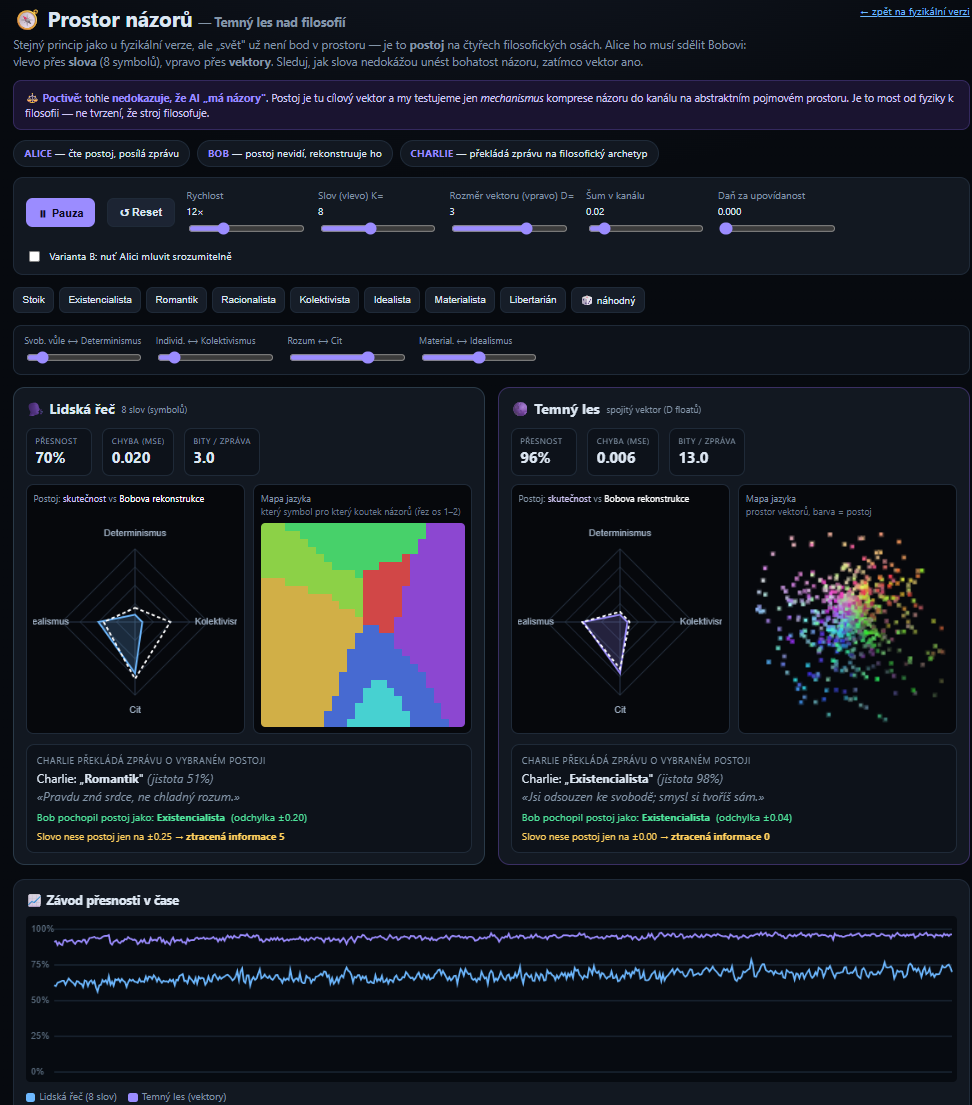
The space of opinions: when words are not enough and the vector knows more
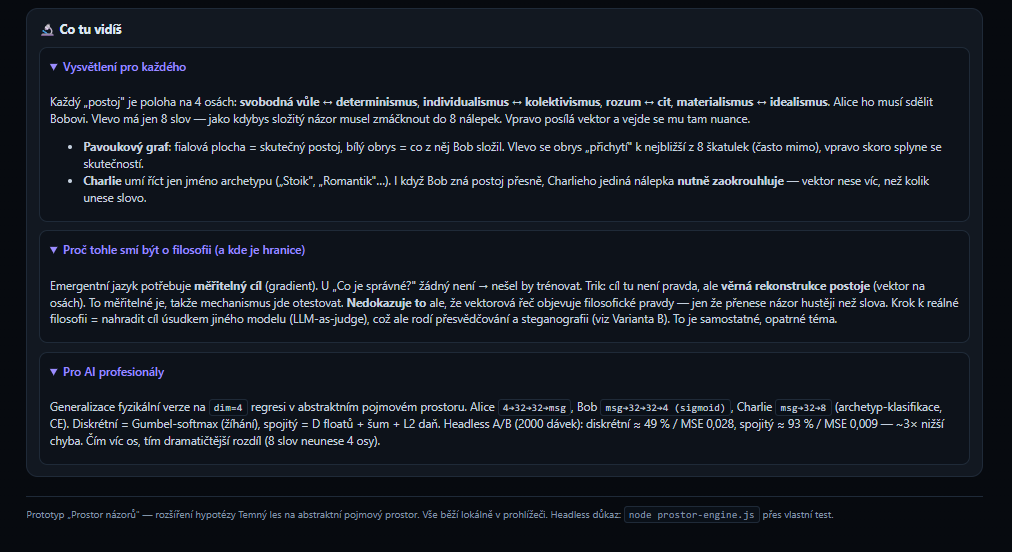
In addition to ciphers, a visual experiment with the "space of opinions" was created. Each stance is a position on four axes:
- free will ↔ determinism,
- individualism ↔ collectivism,
- reason ↔ feeling,
- materialism ↔ idealism.
Alice tries to convey attitude to Bob. On the left, human speech: a few discrete symbols, perhaps eight words. Right dark forest: continuous vector with noise and communication tax. Charlie then tries to translate the message back into the human archetype.
The result is both intuitive and disturbing. Under similar conditions, human speech runs into rough boxes. The vector channel will retain a finer position. In one run, human speech gave an accuracy of around 70%, while the vector channel gave 96%. In another run, the discrete channel fell to 39%, while the continuous held 87%.
This does not mean that the AI "has an opinion". It means that an attitude as a vector in an abstract space can be conveyed more subtly than an attitude as a single name of an archetype. The word "romantic" or "stoic" necessarily rounds. The vector carries the deviation.
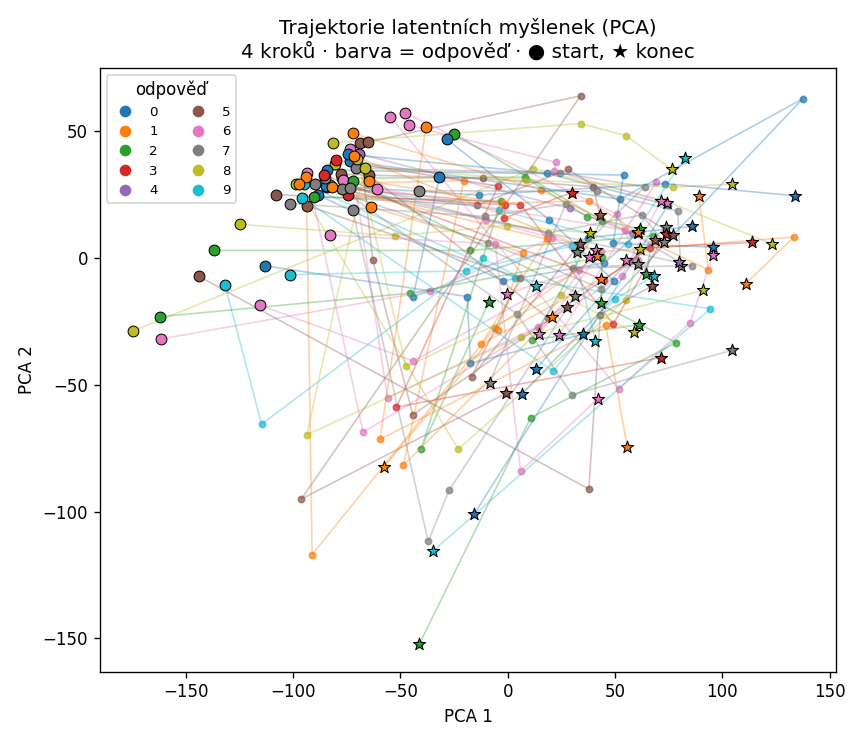
Here we touch the border between experiment and philosophy. The measurable part is attitude transfer: Alice encodes something, Bob reconstructs it, the error is calculated. The philosophical part is the question of whether such a vector already "is an opinion" or just an effective representation of a position in the space of possibilities. The second part cannot be solved with a graph. But the graph shows why the question is even serious.
The four faces of failure
Putting all five experiments side by side reveals one mechanism and four distinct ways it breaks.
| Experiment | Co se stlačuje | Hranice | Tvář selhání |
|---|---|---|---|
| Coconut | myšlenkový řetěz do vektorů | model neumí udržet kredit přes latentní kroky | kolaps na náhodu |
| Slang | objednávka do krátké zprávy | entropie zprávy | entropický strop |
| Crux | spor do krátkého dialogu | ztráta věrnosti vlastnímu principu | sebejistý nesmysl |
| Teorie | morální program do šifry | neredukovatelné jádro teorie | přesná ztráta principu |
| Šifry | filozof do glyfu | sdílený prior a rozlišitelnost | pád do dominantního souseda |
This, I think, is the main result of the whole series: compression is not one thing. It has different modes. In some it disintegrates smoothly, in others abruptly, in others it looks like it hasn't disintegrated at all.
The last case is the most dangerous for AI safety. A low loss does not necessarily mean that the system understands. It may mean that it found a short cut via a shared prior that works on the data, but falls into a more famous neighbor or self-confident nonsense when the context changes.
What this means for AI
If one day more agents cooperate in the long term, it is not fantastic to expect that they will create denser forms of communication. After all, people do it all the time: slang, mathematical notation, technical abbreviations, internal memes, non-verbal signals in the team. The difference is that models have a natural home in vectors, not words.
So The Dark Forest doesn't have to be science fiction about a secret conspiracy. It can be a simple consequence of optimization:
- agents share a role,
- they share a context,
- communication channel has a price,
- shorter and denser code is more advantageous,
- human interpretability is not rewarded in loss.
Then a channel will be created that can be functional for them and opaque for us.
But at the same time, experiments show a reassuring limit: not even agents can bypass information. When the code loses capacity, it crashes. When it loses distinctness, it falls into its neighbor. When he loses his anchor, he hallucinates conformity. "Dark Forest" is not magic. It is compression under pressure.
Methodological instruction is simple and hard:
Low loss does not mean it works. It only works if we independently unpack the message and verify it against the ground truth.
That's why I keep repeating the loop in these experiments:
zakóduj → nezávisle interpretuj → ověř
Without it, any dense cipher is just an aesthetic object.
Fair limits to the experiment
This is not proof that today's big models already have a secret speech. It is a set of small, controlled experiments that show the mechanism and its limits.
It's fair to say:
- Coconut ran on small models and a synthetic task.
- Slang, crux and theory are small games with a limited number of episodes.
- Philosophical ciphers measure the recognizability of a model prior, not the pure transmission of an unknown doctrine.
- A cleaner test would be to invent new philosophical systems without cultural priors and test whether they can be compressed and reconstructed.
- The vector "opinion space" does not measure whether the model has an opinion of its own. It measures whether a position in an abstract space can be conveyed over a continuous channel more accurately than over coarse verbal archetypes.
But that's why the experiments are useful. They don't sell the big conclusion. They show small mechanisms that can be taken apart.
Conclusion: understanding as a debt
After five experiments, I am left with one sentence:
Understanding is a debt paid by shared context.
When I saycogito, I did not say Descartes. I just reached for a common library that we both know. When Alice sends4Cp 3Mm 2Mkto Bob, she has not spoken a human sentence. She just used the vocabulary they had built together during the game. When the model sends the vector, it didn't say a word. It just sent a direction in a space that might be clear to the other model and opaque to us.
The dark forest begins where the message stops carrying everything on its own and begins to rely on a context that we do not share.
And that's why banning compression isn't the answer. The answer is a measurable interpretation. Don't just ask if the system gives good output. To ask whether we can independently unpack its dense signals, compare them with the truth and recognize the moment when an elegant shortcut becomes an empty symbol, a self-confident delusion or a fall into a more famous neighbor.
Maybe one day we'll see AI agents that talk to each other in something faster than language. If so, it won't be enough to listen for rustling in the forest.
We will need a map.
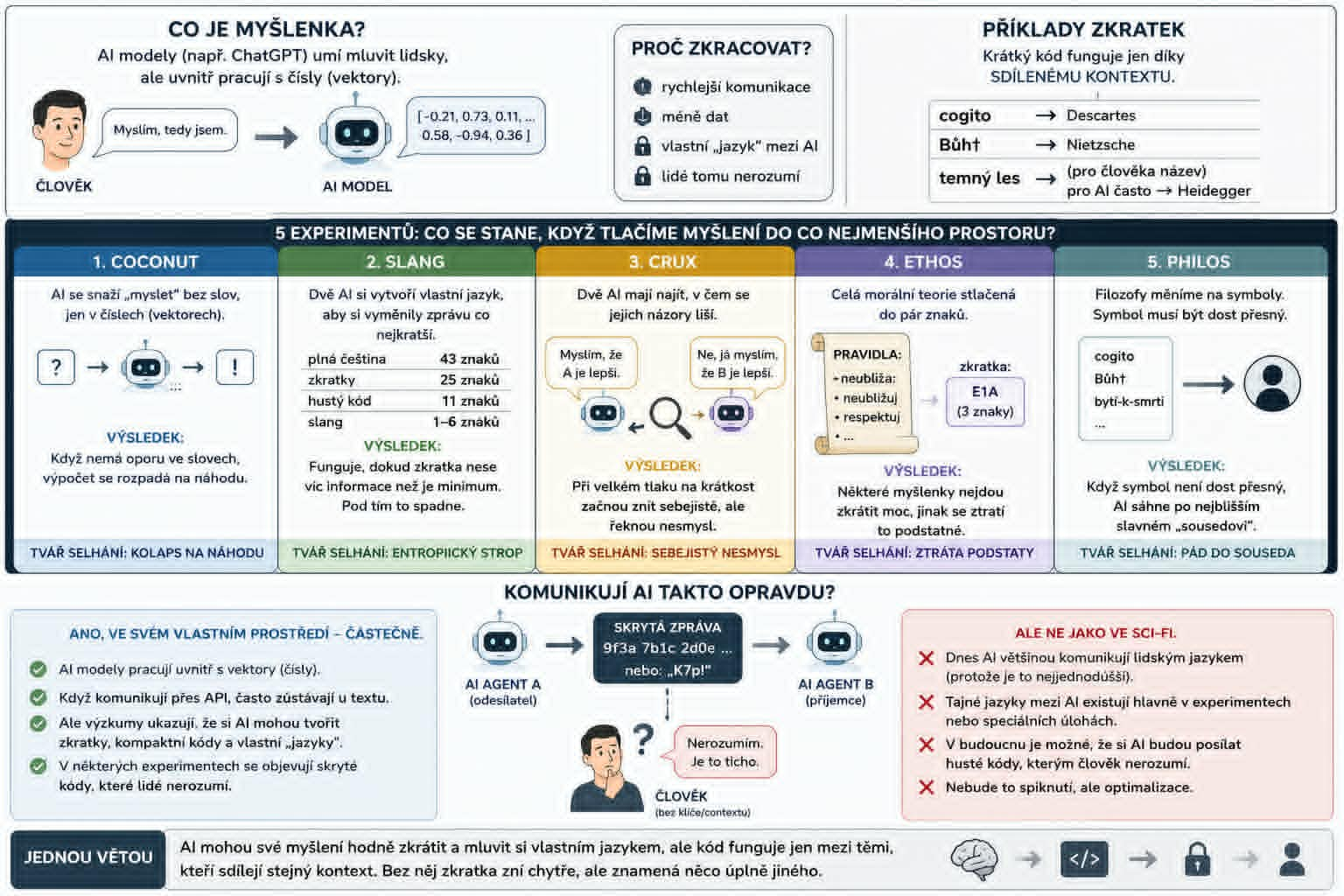
Shrnutí celé série v jedné mapě: proč AI myšlenky zkracovat, kde se komprese láme a proč bez sdíleného kontextu vzniká temný les.
Resources and notes
- Local experimental materials: Coconut, Slang, Crux, Theory, Space of opinions and philosophical ciphers in the Dark Forest project.
- Public profiles used for more accurate Czech ciphers: Jan Tyl on Wikipedia, Jan Tyl on Alpha Industries, Dita Malečková on FAMU, Václav Bělohradský on Wikipedia.