Digital jungle or digital cage? What phones, social media and AI really do to children
Czechia is debating phones in schools, France social media under 15, and children already use generative AI every day. What the evidence actually says, why experts disagree, and how to set boundaries that protect children without leaving them unprepared.

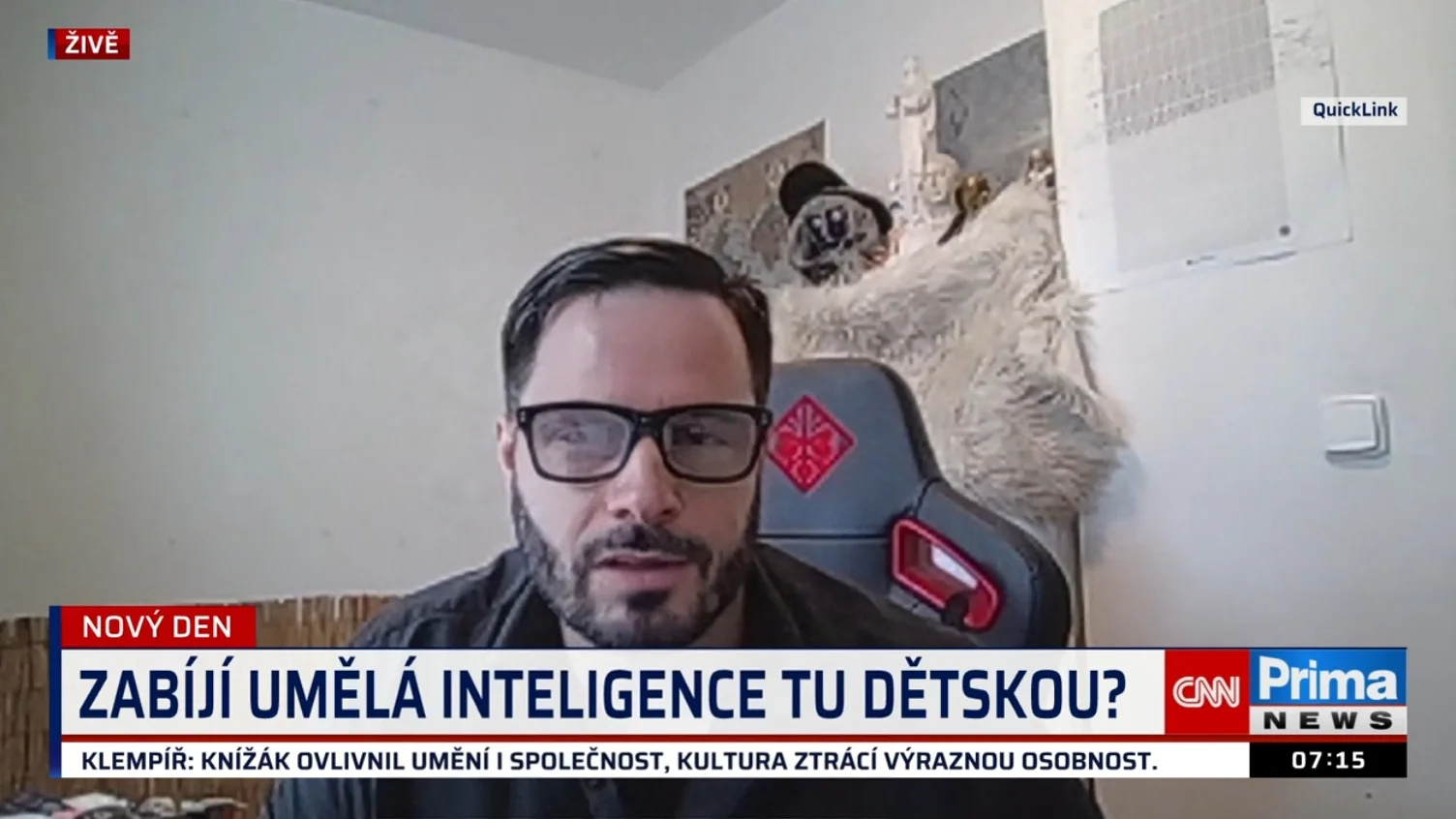
Broadcast live · CNN Prima NEWS · Nový den · 27 July 2026
This morning I joined Nový den to discuss phones in schools, children's social media use, creativity and generative AI. This article adds the deeper evidence base for viewers, parents and teachers: what we know, what remains uncertain, and why a simple ban addresses only part of the problem.
Watch the full Nový den programme on CNN Prima NEWS

Imagine two pupils of the same age. One watches an endless stream of short videos under the desk during maths. The other asks an AI tutor on the same phone why an equation does not work. The device is identical. The effect may be the opposite.
That is why a debate about “phones” is often too crude. It mixes up the device, content, pattern of use and the child's situation. A phone can be a distraction, a learning aid, a link to a parent, a tool for cyberbullying or a medical device. Social media can provide community and also enable compulsive scrolling at night. Generative AI can be a good tutor, a bad ghostwriter or a highly risky pseudo-friend.
My central claim is simple:
Children need boundaries, but a ban cannot educate them by itself. AI should help a child think, not think instead of them.
Czech schools
93%
already regulate phones in their school rules. Ministry survey 2026, response rate above 99%.
Problematic social media use
11%
of adolescents in WHO/HBSC 2022, up from 7% in 2018.
UK school-policy study
1,227
pupils in 30 schools. Stricter rules alone were not linked to better wellbeing or grades.
Child AI users
1 in 10
turns to AI for advice about things that worry them, according to UNICEF. These are not Czech data.
Czechia: a new ban, or a common baseline for what schools already do?
The most important distinction is between current law and a proposal. Czech schools can already limit or ban phones through their internal rules. A May 2026 Ministry of Education survey found that 5,083 schools, or 93%, do so. During lessons, the most common model is a ban with teacher-directed exceptions. Policies vary most during breaks.
The new Parliamentary Bill 232, submitted by Andrej Babiš and Robert Plaga, is still a bill, not law in force. The government endorsed it on 20 July 2026. If adopted, it would apply from 1 September 2027 during lessons and related educational activities in kindergartens, primary schools and lower grades of multi-year grammar schools. Health and teacher-authorised uses are expected to remain exempt.
The dispute is therefore not “rules versus no rules.” It is about a national baseline, its scope, and how much discretion remains with schools and teachers.
Do school phone bans work?
The most accurate answer is: for some goals, yes; for others, not on their own.
The SMART Schools study compared 20 restrictive and 10 permissive English schools. Restrictive policies reduced phone use during school by 0.67 hours and social media use by 0.54 hours. Yet they were not associated with better mental wellbeing, sleep, physical activity or academic attainment, and total weekday and weekend use did not differ.
SMART Schools · England 2025
Less phone at school, not less phone in life
A Norwegian quasi-experiment tells a different but compatible story. The Norwegian School of Economics reports that bans improved girls' grades and maths results, reduced bullying, and increased the likelihood of choosing an academic high-school programme. Effects were strongest for girls and disadvantaged groups.
The studies asked different questions. Together they suggest that restrictions have a strong rationale for attention, school climate, unwanted recording and some bullying, but do not guarantee a rapid population-wide improvement in mental health or grades. The most vulnerable groups may benefit more than the average.
I therefore favour a phone-calm school, not a technology-blind school: phones are not freely available entertainment, but teachers can use devices purposefully and reasonable health and safety exceptions remain.
What 2026 research adds to the bans debate
New evidence supports a measured conclusion: clear classroom rules make sense, but a stricter ban does not automatically produce a larger health benefit.
- A Dutch observational study of 1,398 students in 24 secondary schools found no advantage of a whole-campus ban over a classroom-only ban for life satisfaction, mental or physical complaints, problematic social-media use or bullying. Full bans were associated with weaker student-teacher connectedness and, among girls, lower school belonging; the design cannot show that the ban caused those differences.
- The first US causal estimate, a May 2026 NBER working paper, found no clear reduction in total screen time or improvement in psychological wellbeing. It uses only one or two post-policy periods and the authors explicitly describe the results as preliminary.
- Interviews with 30 adolescents suggest that some students welcome a rule that removes the urge to check, but legitimacy, safety contact, practical alternatives and understandable exceptions shape whether a policy works in real life.
Social media: Haidt versus the more cautious evidence
Social psychologist Jonathan Haidt advocates four clear norms: no smartphone before high school, no social media before 16, phone-free schools, and more independent play in the physical world. His important contribution is to frame this as a collective-action problem: it is hard to be the only family that says no.
Researchers such as Candice Odgers, and the US National Academies consensus report, are more cautious. Their review did not support the conclusion that social media alone causes population-level changes in adolescent health. Average effects are heterogeneous and depend heavily on the child, content and pattern of use.
That does not mean “no risk.” A JAMA Network Open longitudinal study followed 11,876 children from age 9–10. When a child used social media more than their own usual level, greater depressive symptoms followed one year later. The reverse pathway was not found in this model. This remains observational evidence, but it is stronger than a one-off correlation.
Three recent studies, three different answers
A Canadian longitudinal study covering 26,743 adolescents linked each additional daily hour, and increases over time, to more depression and anxiety symptoms, lower flourishing, poorer relationships and weaker emotional regulation at follow-up. London's SCAMP cohort followed more than 2,300 children from age 11–12 to 13–15: after adjustment, more than three hours a day was associated with roughly 47% higher odds of clinically significant depressive symptoms and 40% higher odds of anxiety symptoms than at most 30 minutes. Combined sleep problems statistically explained about 38% and 26% of those associations.
By contrast, a fresh five-year Swedish cohort began with 5,535 ninth-graders and followed up 3,193. An unadjusted relationship with later depression and anxiety disappeared after confounders were considered. None of these studies is a randomised experiment. Together they say that time can flag risk, but it is a crude measure: content, compulsivity, displaced sleep and offline support matter.
WHO / HBSC 2022
Problematic does not simply mean frequent
The measure covers loss of control, withdrawal-like feelings, neglected activities and negative consequences.
WHO also found that heavy but non-problematic users can report stronger peer support. The highest risks cluster around lost sleep, cyberbullying, harmful recommendations, appearance comparison, loss of control and individual vulnerability.
Two new Czech HBSC network analyses reinforce the importance of context. One examined support systems among 5,487 Czech 15-year-olds; another compared extracurricular activities among 14,588 adolescents. They use 2022 observational data and do not establish causality, but show that problematic use is intertwined with family, peers, school support, self-support and meaningful offline activity.
Scientific uncertainty does not mean no risk. It means interventions should be targeted and their effects measured.
France: a ban under 15, with implementation still unresolved
Since 2023, France has required parental consent for social-network registration below age 15. A new text adopted by Parliament on 21 July 2026 goes further, banning access under 15 with limited exceptions and aiming to cover new accounts from 1 September 2026.
As of 26 July, two caveats matter. Constitutional review is still pending, while the French Senate debate itself raised proportionality, definitions and enforceability. Age verification is the second challenge: finding children requires platforms to assess the age of everyone.
This does not have to mean sending an identity card to every service. The European Commission's prototype is designed to prove that a threshold is met without disclosing identity or exact age. Its DSA guidance also recommends private-by-default child accounts, more control over recommendations and limits on addictive design.
Generative AI: tutor, crutch or ghostwriter?
Two high-quality experiments show why design matters.
A Harvard randomised trial compared a carefully designed AI tutor with high-quality active learning in undergraduate physics. The AI group achieved more than twice the median learning gain, spent a median 49 rather than 60 minutes learning, and reported greater engagement and motivation. This was not an open chatbot: it used expert material, sequencing, scaffolding and feedback rules.
A field experiment by Bastani and colleagues with nearly 1,000 Turkish high-school maths students showed the other side. Open GPT-4 improved practice performance by 48%, but after the tool was removed students scored 17% worse than the control group. A safeguarded version using teacher-designed hints and refusing to reveal complete solutions improved practice performance by 127% and largely eliminated the later harm.
Good tutor
Asks questions, gives graduated hints and lets the child attempt first.
Bad ghostwriter
Produces the assignment but may remove the experience from which skill grows.
Risky companion
Simulates a relationship, constantly agrees and may displace people or professional help.
The practical rule is:
Think first. Ask AI second. Then verify the AI and defend your reasoning.
AI-text detectors are not a reliable solution. Schools should ask for drafts, transparent disclosure, sources, oral defence and some unaided performance. The process matters, not only the product.
A 2026 survey of 4,354 US high-school students in six schools adds a useful correction. The share reporting at least one measured form of cheating remained about 72%, in line with historical US baselines. AI had not produced an overall explosion in self-reported cheating, but it changes its form and makes outsourcing an assignment cheap. Among AI users, concept explanation (81.6%) and idea generation (68.7%) were the most common uses. Schools should therefore verify reasoning, understanding and unaided performance, not only inspect the final prose.
AI is already more than homework help
A new UNICEF brief draws on nationally representative surveys of roughly 1,000 internet-using 12–17-year-olds and 1,000 parents in each of ten countries. AI use ranged from 18% to 50%. Among child AI users, 60% used it for homework, 47% for information and 11% for advice about things that worried them.
These are neither Czech nor globally representative estimates, but they show a change in role. UNICEF warns about cognitive offloading, bad advice, sexual deepfakes and emotional dependency on companion chatbots, while acknowledging that long-term evidence on children's social and emotional development is still scarce.
AI may help an introverted or neurodivergent child rehearse a conversation or prepare for a difficult situation. The decisive question is whether it becomes a bridge to people or a substitute for them.
What should change now?
Parents: keep phones out of bedrooms at night; look beyond minutes to content and loss of control; model the rules themselves; explore AI together and explain hallucination, flattery and privacy.
Schools: set clear rules for lessons, breaks and exceptions; preserve genuinely phone-free social spaces; distinguish disclosed AI-assisted work from unaided assessment; teach verification, sources and manipulative design.
Government: evaluate outcomes after rules are introduced; support parents, teachers and mental-health prevention; pursue privacy-preserving age assurance and safety-by-design at EU level; invest in teacher AI literacy.
Platforms and AI developers: make child accounts private by default; limit infinite feeds, night notifications and extreme recommendations; prevent manipulative dependency in AI companions; measure safety by real-world outcomes rather than time in app.
My conclusion
Haidt is right that families cannot individually defeat a collective norm and an industry optimised for attention. More cautious researchers are right that effects differ across children and that correlation is not a single-cause story. WHO is right to focus on loss of control and concrete mechanisms, not every minute online. AI experiments show that the same model can strengthen or weaken learning depending on whether it provides structure or a shortcut.
The best protection is therefore neither unlimited access nor a ban alone. It combines reasonable boundaries, safer platforms, adults who model good habits, and a child's ability to recognise when technology serves them and when they have begun serving it.
We should not lock children out of the digital world and then throw them into it at fifteen without preparation.
Technology should extend a child's abilities and relationships, not replace them.
Questions and answers: the short, accurate version
How can AI help children at school, and when does it harm them?
Used well, AI can be a patient tutor: it explains a topic in several ways, responds immediately to mistakes and adapts the level. It works best when it asks questions, gives graduated hints and lets the child attempt first. The OECD Digital Education Outlook 2026 reaches the same conclusion: pedagogically designed tools can support learning, critical thinking and collaboration, while outsourcing tasks to a general chatbot can improve performance without producing learning.
Methods that make the child think actively have the greatest potential: Socratic questioning, playing devil's advocate, seeking counterarguments, comparing several solutions and defending one's own view. One of the best routines is to think through a task independently, write down an initial position and only then ask AI. The child can compare both perspectives, notice the surprises and decide which argument survives scrutiny. This use does not shorten thinking; it activates different layers of it.
An exploratory UK randomised trial with 165 pupils in five schools found a 5.5 percentage-point advantage on novel problems when LearnLM was used under human-tutor supervision. It is an encouraging preprint, not definitive evidence for every child and subject.
Used poorly, AI removes the effort through which skill grows. A Czech study of 2,307 seventh graders found no robust positive association between frequency of GenAI use and maths or Czech achievement; believing that prompting matters more than understanding was negatively associated with achievement. The study is cross-sectional and does not establish causality.
How do we stop AI replacing personal relationships?
A ban alone is not enough. AI can help rehearse a conversation, name an emotion, view a conflict through another person's eyes or prepare questions. Well-designed AI does not replace relationships: it can train empathy, communication and conflict resolution, then lead the child back to people. An important personal problem should still lead to a trusted person. UNICEF found that 11% of child AI users in its ten-country survey sought advice about worries. This is not 11% of all children and not a Czech estimate, but it is a warning.
The practical rule is AI as a bridge to people, not a substitute for them. Particular care is needed around sycophancy: some models agree too readily, flatter users and reinforce their perspective when a sensitive challenge would be more useful. Families and schools need real group work, play, disagreement and reconciliation without a screen. Child-facing bots must not build manipulative dependency, pretend to be human or discourage contact with parents, teachers or professionals.
What are schools struggling with, and how should they address cheating?
Teachers often cannot see how a polished final text was produced, and unreliable AI detectors do not solve that. Schools should ask for outlines and drafts, disclosure of tools, traceable sources, a short oral defence and some unaided performance. Assessment must examine the process and understanding, not only the product.
Part of the problem is uneven AI literacy among teachers. It is difficult to teach children responsible use of a tool that the teacher cannot use confidently. The strongest defence is therefore not only supervision but the teacher as a role model: using AI openly, exposing its mistakes and demonstrating source verification aloud.
What about hallucinated or unverified information?
A language model is not a truth database. When search is disabled, the answer is not grounded in trusted material and its sources are unclear, it may hallucinate a fact, quotation or link with confidence. Search, supplied documents and transparent citations substantially reduce the risk but do not eliminate it. For an important claim, a child should separate the claim from the explanation, request a specific source and date, then open the original source and check that it says the same thing.
Use search, trustworthy sources and critical thinking. Always inspect an important source yourself.
Does AI kill originality and imagination?
Poorly used AI can average creativity out. Well-used AI can develop it in many directions. Accepting the first generated idea teaches convergence on the probable. Starting with one's own ideas and asking AI for criticism, an opposing view, unusual constraints or radically different variants widens the search space.
A systematic review of 67 empirical studies finds this distinction between structured use that may support critical and creative thinking and passive outsourcing that can lead to cognitive offloading and homogenisation. It examines higher education, so its findings should not be automatically generalised to children.
The useful rule is human first, AI second: create three ideas, use AI as critic or provocateur, then make and defend the final choice yourself. AI should widen the search space, not choose instead of the child.
What will phone and social-media bans achieve?
Blanket bans require great care so that protection does not remove valuable learning at the same time. Clear classroom rules and genuinely phone-free periods make sense, but a distracting phone, an addictive social feed and teacher-guided use of AI are not the same thing. Used well, AI can educate children and prepare them for work and life in a world where it will be commonplace.
A blanket ban does not automatically improve grades, sleep or mental health if habits simply move home. In Czechia, a national ban remains a bill, while 93% of schools already regulate phone use. The priority should be learning to use technology well, not banning something merely because we do not yet understand it sufficiently.
France adopted a text banning social networks for under-15s on 21 July 2026, but constitutional review, age assurance, privacy and practical enforcement remain open. It is too early to call it either a success or toothless; it is a major European experiment whose outcomes must be measured.
Five-point checklist
- 1. Try independently before asking AI.
- 2. Use AI for hints, not as a substitute for work.
- 3. Verify important claims outside AI.
- 4. Let personal problems lead to a person.
- 5. Preserve time without phones or AI every day.
The goal is not to raise children without technology. It is to help them recognise when technology assists them and when it starts thinking, deciding or replacing relationships for them.
Key sources
- Czech Ministry of Education: 93% of schools regulate phones
- WHO/HBSC: social media and gaming
- National Academies: Social Media and Adolescent Health
- SMART Schools study
- Dutch full versus partial bans study
- NBER: Youth Mental Health and School Smartphone Bans
- JAMA Network Open longitudinal study
- BMC Medicine: SCAMP, social media, sleep and mental health
- Swedish five-year cohort
- Scientific Reports AI tutor RCT
- Bastani et al.: Generative AI Without Guardrails Can Harm Learning
- AI chatbots and high-school cheating
- UNICEF: AI Usage and Concerns Among Children and Parents
- OECD Digital Education Outlook 2026
- LearnLM exploratory UK school RCT (preprint)
- Czech study of GenAI use among 2,307 seventh graders
- Systematic review of 67 critical- and creative-thinking studies in higher education