AI did not become human this year. It became a new layer of work
Notes from the Slunovrat festival in Opava: why the AI debate has shifted from responding to doing, what jagged intelligence is, and why I'd rather build a big plow than a big stick.

This was my second year at the Slunovrat festival in Opava, but the first time only virtually. My body stayed in Prague; my spirit appeared on a screen in the beautiful space of the Church of Saints John. In the hall, Michal Kubíček was sitting next to the moderator Leoš Kyša, I joined remotely, and we had a debate about artificial intelligence without embellishment and without unnecessary hype.
A year ago, we mainly dealt with how well the AI responds. This year we tackled something different: how well it works. And that's not a cosmetic difference. It is perhaps the most important shift of the last twelve months.
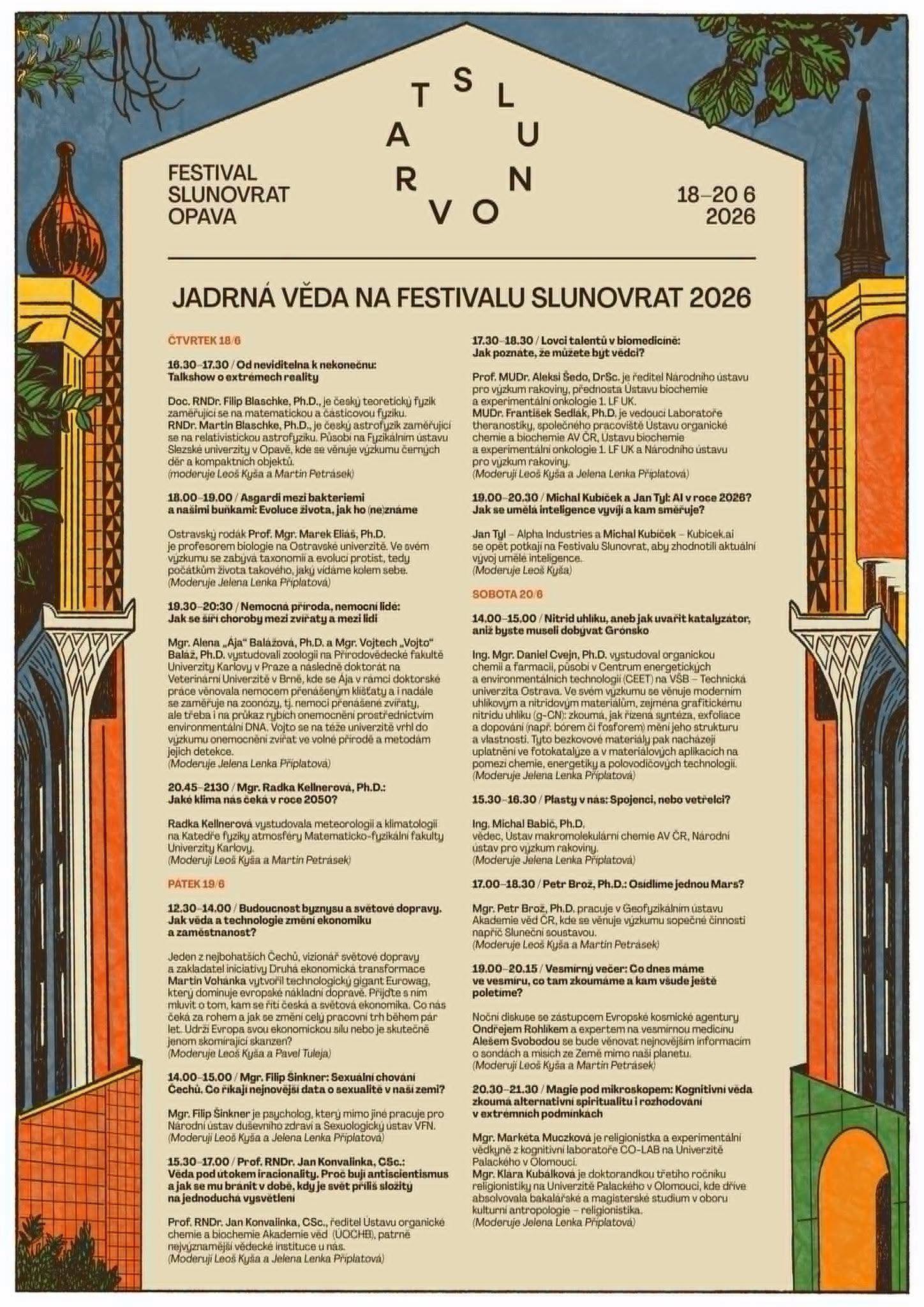
Slunovrat festival 2026 in Opava. On Friday evening, we talked with Michal Kubíček and Leoš Kyša about where AI has moved in a year and what it means for work, security and education.
The models didn't just start writing a little better. We see a shift in creative writing, but the shift is even more pronounced in the ability to actually build, program, plan, and execute something. The difference can be well illustrated on the Arena-type rankings: in creative writing, the top moved by dozens of Elo points, while in practical web and agent tasks the jump was many times greater.
In other words: AI did not just get better at writing essays. It got much better at doing work.
Access to a top model is not guaranteed
One theme that could not be avoided this year is the fragility of dependence on a single provider. Whether it's security interventions, product changes, export regulation, or business strategy, the best model can disappear from your workflow much faster than we would have thought a few years ago.
That, I think, is one of the biggest lessons of the current AI era. If a company, school or state builds everything on one proprietary model, it is voluntarily creating a dependency. It's not just about the price. It's about availability, usage rules, provider policy and responsiveness when the market changes.
This is precisely why I am interested in architectures that do not rely on one omniscient head. At Alpha Industries, we've been working in a direction that brings multiple models, tools, and resources together for a long time. In the last articles I wrote about it for HyperFusion and for the newer DRACO benchmark.
It is not just about resilience. It's also about quality. One model has blind spots. A panel of models can offer more perspectives if we know how to manage and evaluate it well.
From answering to doing
An example was given in Opava that describes it better than an abstract definition. Previously, one would take the list of categories in the e-shop, export it, translate it, check it and import it back. Today, the agent can be given a task: open the administration, translate the categories, check the result and let me know when you're done. You don't write every step anymore. You describe the goal and check the result.
This is a huge change. The programmer gradually changes from the person who writes each line to the architect of the agents' work. One agent designs the database, another writes the frontend, a third looks for a security problem, a fourth reads the documentation. The person decides what should be created and whether it makes sense.
This does not only change productivity. The nature of expertise is also changing. Expertise does not lose its value, quite the opposite. The more precisely you know what you want, the better the agent will do for you. The bottleneck is no longer just writing code or text. The bottleneck is knowing what to build, why and how to know that it is good.
Jagged intelligence
If there is one concept I wish people could take away from the entire debate, it would be this: jagged intelligence.
AI today does not seem like a uniformly smart human. More like a landscape full of sharp peaks and deep holes. In one area it solves tasks at the level of the best students on the planet, in another it makes a mistake that one would consider ridiculous. It can write a program, propose a strategy, summarize a technical text, but then it fails on a banal detail that you don't expect.
This is why public debate so often goes to extremes. One person sees a genius answer and says, "It's here, it's going to replace us all." The other sees a silly mistake and says, "It cannot even do basic things." Both have some truth. AI today is capable of being both brilliant and simple-minded at the same time.
The art is knowing where we stand. Are we at the top where the model actually helps? Or in a hole, where it just fluently and confidently makes a mistake?
I'd be more afraid of boring things than the Terminator
Sooner or later, the Terminator will appear in AI debates. But I would be less afraid of a cinematic rebellion of machines and more afraid of ordinary things that are already ahead of us.
Cyber security, for example. AI lowers the barrier to entry. What used to require deep expertise, today even a less experienced attacker can try with the help of the model. On the other hand, the opposite is also true: the same tools can help defenders find vulnerabilities, write tests, check configurations, and harden systems. It's not a reason to panic. It's a race of preparedness.
The second risk is the information environment. Not so much the robots on the battlefield, but the small, persistent shifting of moods, opinions and trust on social media. Hybrid war is not dramatic like a movie. That's why it's dangerous.
And the third thing is cognitive debt. Not as a disaster, but as something to watch out for. When AI writes, plans and analyzes for us, it's tempting to stop thinking for ourselves. But I think the best use of AI is the opposite. Take it in a Socratic way: as a debate partner who asks questions, offers counter-arguments and forces us to think things through.
When I sometimes say that AI should give us "headaches", I don't mean suffering. I mean we should use it to make us think, not to outsource thinking.
For facts, AI is the beginning of the work, not the end
One particular type of error is worth repeating over and over again: AI can very convincingly hallucinate citations, legal provisions, studies and court rulings. It sounds authoritative, it fits formally, the language is beautiful, but the source does not exist.
This is no reason to dismiss AI. It's a reason to change the workflow. For facts, legal references, citations, medicine, money and reputation, AI is the beginning of the work, not the end. The model can help to find direction, prepare research, design a checklist. But the final claim must be verified.
This lesson is especially important because right now AI is making its way out of the hands of enthusiasts and into regular offices. When used by an expert, it can become a powerful aid. When used by a person without verification, it can become a generator of confident falsehoods.
A big plow, not a big stick
In the debate, we also came to the image of a "big stick". If we are to get our own strong AI mainly because others will have it too. I proposed to turn the image around: instead of a big stick, a big plow is preferable.
Artificial intelligence is a tool. You can hit someone with a stick, but you can also turn it into a handle, a lever, or part of a plow. Framing AI primarily as a giant weapon that we should all fear leads to paralysis. It is much more useful to learn how to use it to improve your daily work.
A spreadsheet that used to take two hours can be done in two minutes. Research that you would put off for a week can start in five minutes. The concept of a lecture, documentation or application can be created in dialogue. This isn't magic. It is a new working tool.
And in the Czech Republic we have a better starting position for this than we sometimes think. I recently wrote about STEM and Eurostat data: according to the STEM survey, roughly 71% of Czech internet users have experience with AI. Adoption is even more pronounced among young people. Among adults we are the European average, but among young people we belong to the European top.
This is not just a statistic. It points to what comes next. The generation now sitting in schools will enter the job market with AI as a matter of course.
Where will it go next?
I don't necessarily expect one AGI to take over everything tomorrow. Rather, I expect a layer of specialized, semi-autonomous agents who will gradually take over a larger part of the digital work: code, spreadsheets, research, documents, planning, search and legal drafts, teaching preparation.
I expect AI to become a second brain, a co-pilot or a colleague. Not in a romantic sense, but in a practical sense: a system that knows the context of your projects, helps keep a long thread running, and knows how to work with other tools.
I am waiting for the first truly significant scientific discoveries where AI will be a substantial co-author of the process. At Slunovrat, there wasn't time to really elaborate on topics like cognitive architecture or the digital scientist, but that's where I think the path is going: bringing together multiple different intelligences, human and artificial, so that the whole can do more than anyone alone.
Robotics will be slower than software, but the first truly useful, more versatile robots in logistics and industry are a realistic scenario within a few years. And we are facing a difficult topic of concentration of power. If most of the planet's intelligence will be controlled by a few companies, it is a bigger problem socially than a single hallucination of a model.
We will deal with cooperation in a year
A year ago we addressed how well AI responds. Today we are dealing with how well it works. And in a few years, we will deal with how well it cooperates.
We at Alpha Industries have been working on this for some time. Sometimes I feel that we are running a little ahead of time, sometimes even uncomfortably. But that's exactly what I enjoy about it. I always wanted to be there when something like the personal computer was born, when a technical toy became a new layer of civilization. This is the moment.
Not with a stick. With a plow.
I thank Leoš Kyša, Michal Kubíček and Opava for the debate, which had a sense of humor and a healthy clash of ideas. Slunovrat is still one of the nicest summer festivals where you can think out loud. And I believe that in a year there will be something to talk about again.
Resources and further reading
- Alpha Industries: Three quarters of the Czech Internet already use AI.
- Alpha Industries: HyperFusion: when one model isn't enough.
- Alpha Industries: HyperFusion after patches: DRACO benchmark.
- Arena AI: model leaderboards for text and web development.
- STEM, Eurostat, METR and Stanford HAI AI Index: publicly available overviews of the adoption, capabilities and limits of current AI.
Note on honesty: the article is based on the debate at the Slunovrat festival and on subsequent documents. I have worded more carefully or left out some of the punchier statements from the working notes where, without a clear source, they would sound exactly like the type of AI hallucination the text warns against.