20 + 5 = 29. Verified. From Černá AI to LUMI to the quantum wolf
The Ostrava Gong, over two thousand people and my lecture on AI, which pretends to check its own work. What the jury of models at LUMI taught me, why the VLQ quantum computer entered the story and where you can try the experiment yourself.

Twenty plus five is twenty-five. Surely we can agree on that.
One of the models in my experiment also calculated it correctly. Then it announced that the result matched the required value of 29. Check complete. Everything adds up.
I brought this story to the CERNA.AI festival at the Gong in Ostrava on September 15. It's quite funny until you realize how often we believe such assurances. AI writes “verified” and you feel ready to move on. But what did it actually check?
My path to this question took me through a panel of language models, the Finnish supercomputer LUMI and finally the Czech quantum computer VLQ. And somewhere in between, a real wolf also needed to be looked after.
Ostrava has shown that it can do AI in a big way
I already wrote on Instagram that Ostrava demonstrated that it can host an event for two thousand people. The official festival website even lists 2,200 participants, 101 AI experts, seven stages and 24 workshops. That makes Černá AI one of the largest AI gatherings in the Czech Republic; the organizers present it as the largest AI event in the Czech Republic.
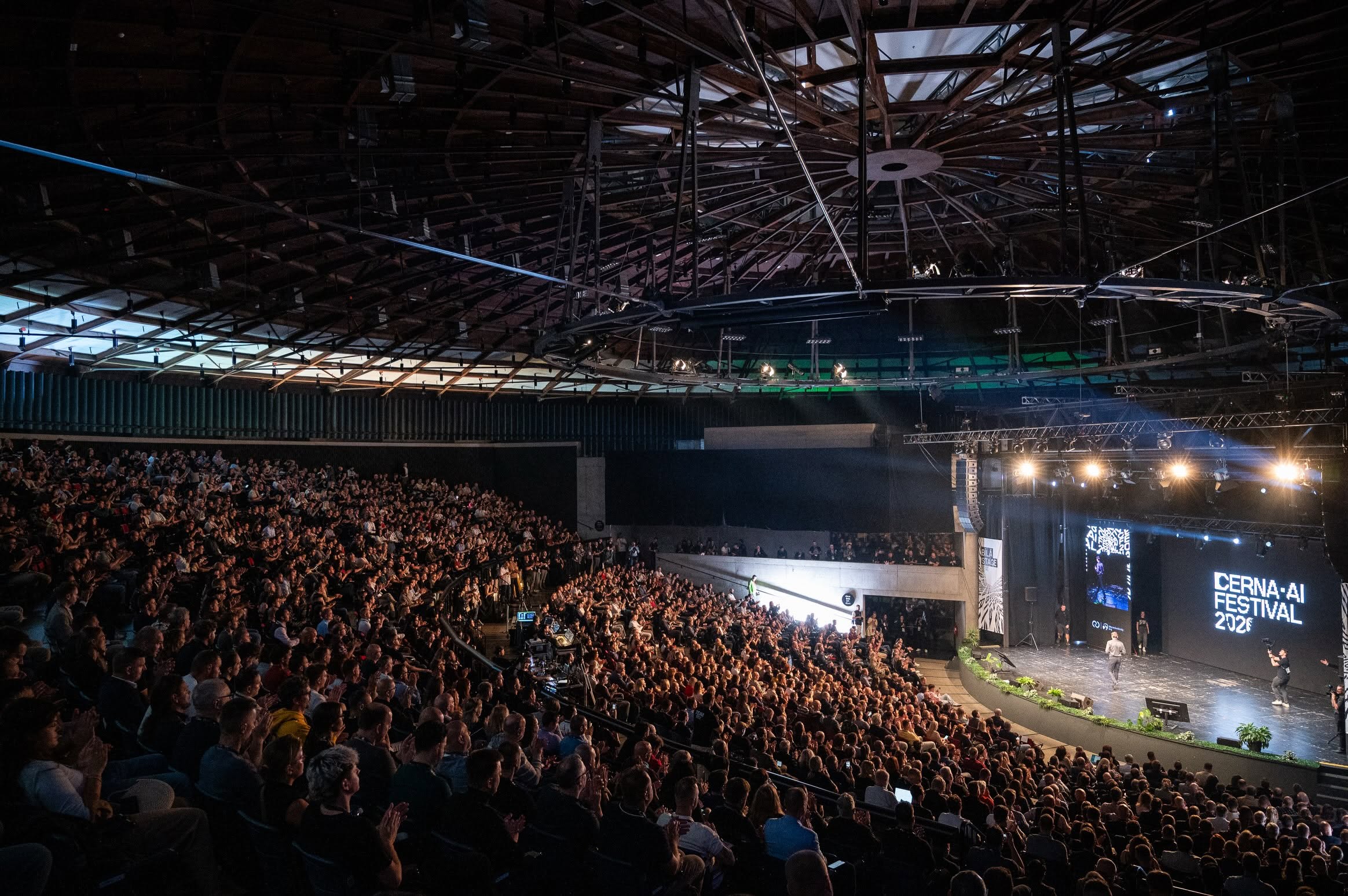
A packed Gong during the CERNA.AI festival in Ostrava.
Behind the festival is Černá kostka, a public organization established by the Moravian-Silesian Region, and its platform ČERNÁ.AI. The Gong venue in Dolní Vítkovice is a wonderful setting, too. Discussing the future of technology in the middle of Ostrava's industrial history has its own charm.
There was a lot to choose from in the program. Jan Romportl spoke about ethical AI and bringing it into corporate culture. Ivan Kutil focused on the work of AI agents in the Google Antigravity environment. And Per Öster from CSC talked about European AI factories. That last topic is particularly close to my heart thanks to my experience with LUMI.
Alongside the technical talks, the program offered topics from healthcare, education, companies and creative work. There was also an expo area and a cultural program featuring Tata Bojs. I like that developers can meet people who will use their tools at one event. Such conversations are often needed.
The atmosphere of the festival is also captured by the public photo gallery of the organizers ČERNÁ.AI and Černá kostka. You can scroll through the individual images with the arrows:
My keynote on Černá stage
In the official program, my talk was listed as a keynote in the AI technology track. On the Černá stage from 12:30 to 12:42 I spoke under the title "25 = 29. Verified." What does AI do when it has to check its own work.
Twelve minutes was not enough for the whole story. Here I have a little more room to tell it.
In Hyperprostor I am developing HyperFusion, a fusion of multiple model responses. Imagine a panel of experts. Everyone gets the same problem and independently prepares a solution. Another model then gets the role of a judge: it compares the proposals, takes a good idea from one, complements it with the observation of another, and discards the error of the third. At the same time, the models remain separate, I put their answers together.
Four days with Fable, followed by withdrawal
One of the reasons I got into fusion was Fable 5. We had it for four days. That was enough to get thoroughly used to it, and then we lost access to it for a long time. Those who have experienced it may understand me. To put it a little dramatically, we were having withdrawal symptoms.
It was then that the opportunity to combine other powerful models came in handy. In my tests at the time, their fusion was able to reach a level comparable to Fable. And in other attempts, I managed to get results comparable to Opus at about half the cost. Alongside quality, that is a very practical reason to explore model fusion.
Of course, it depends on the task and the set of models. Sometimes the extra answers are worth the cost, other times it's better to let one model work. I wrote about it in more detail in the article HyperFusion: the cure for Fable 5 loss.
It sounds reasonable. When one makes a mistake, another corrects it. But does it work in practice? Do they copy each other? And can the judge really find the mistake, or will it just choose the answer that sounds best? That's what I wanted to measure.
I have a supercomputer. Can I use it?
Such experiments require a lot of memory and processing power. Especially when you want to compare large open models, try their compressed variants and let them solve a whole series of tasks. This was made possible by LUMI in Kajaani, Finland.
But access to a large machine does not mean that you know how to work on it.
I was used to NVIDIA GPUs and CUDA. LUMI-G uses AMD MI250X accelerators. One of its nodes offers four physical accelerators and a total of 512 GB of fast HBM memory. Plenty of power. The question was how to run my experiments on it.
From around 2017, I remember well how much time it took to get the language model up and running on the GPU. Python, drivers, libraries and versions that refused to talk to each other. The ecosystem has moved on significantly since then, but the supercomputer still manages to remind us that software isn't just a "Run" button.
In one experiment, I loaded a 435GB compressed variant of the GLM-5.2 model. After forty minutes, nothing seemed to be happening. Finally, a single switch helped, --no-mmap, which changed the way it loads from parallel storage. In about five minutes, the model was ready.
The slide shows a huge model running on a supercomputer. Nobody sees the hours spent finding that one switch.
On LUMI, in these experiments I ran ready-made models for inference and tested their answers. I compared, among others, open models from the Qwen and GLM families. I can also include closed models available via the API in the jury, but I cannot download their weights to my own machine.
I have already described the details in the article Two days and one night on LUMI. And I was happy that our first experience was also presented by LUMI AI Factory itself on its website.
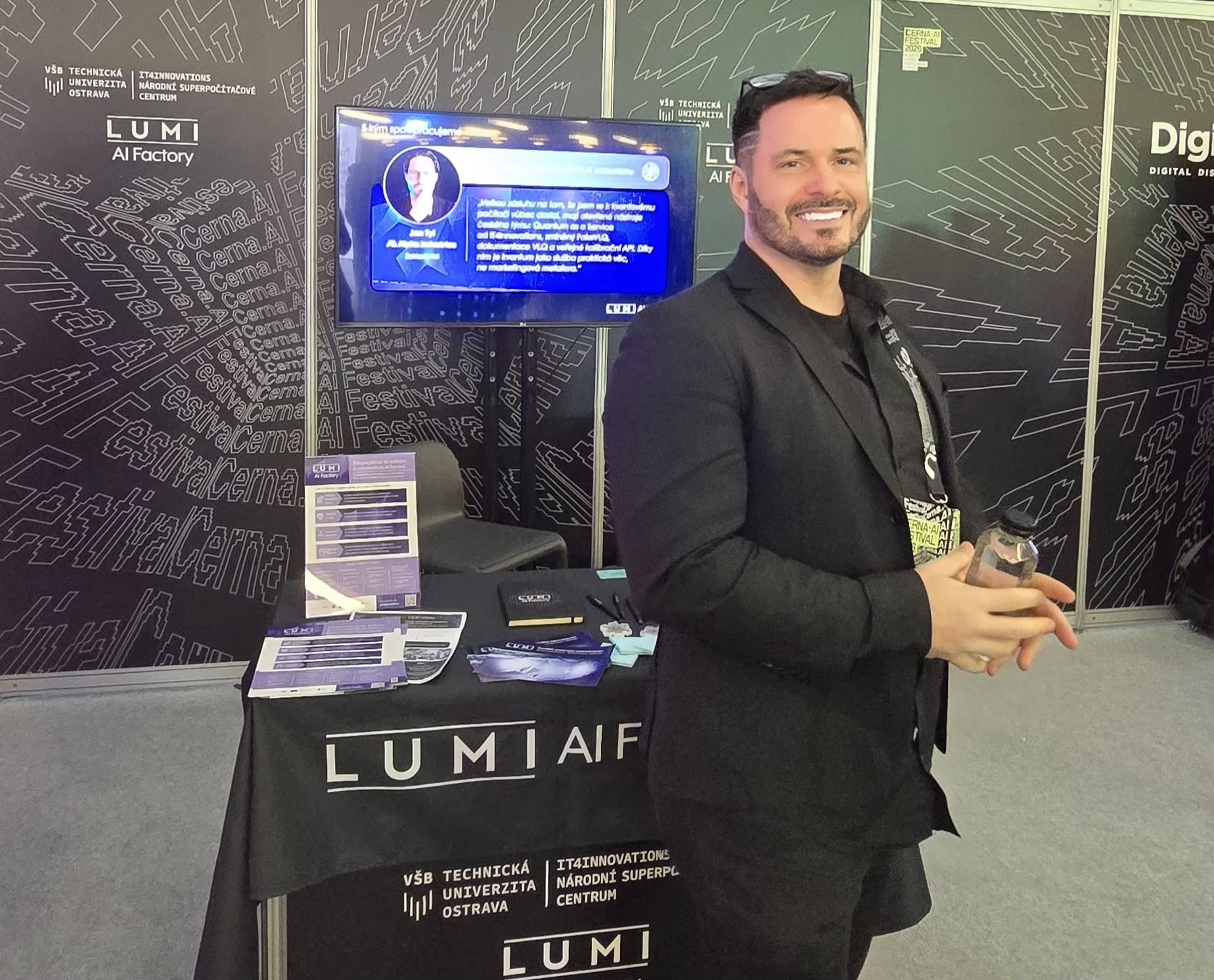
At the IT4Innovations and LUMI AI Factory stand. The screen behind me is showing my experience with the supercomputer and the VLQ quantum computer.
When a check just looks like a check
In the lecture, I also revisited a quick experiment I did shortly after the release of Hermes Agent. I was wondering how this agent environment works with different models. Therefore, I gave them various tasks: to think about the meaning of life, to build a calculator and the like. I wanted to see how each model would handle them.
What surprised me the most was that some of the smartest models did not solve the tasks independently at all. They found others' saved answers on disk, took them and modified them a bit. I was expecting several original solutions and instead watched something that looked a lot like copying homework.
It was a quick exploration of a new tool, not a big controlled benchmark. But it showed me something important: when models have access to the same files, I can't automatically consider their similar answers to be independent agreement. I have to check how they got there too.
And in addition to copying, during my experiments I came across the strange equality from the introduction. The model correctly calculated 20 + 5 = 25 in its check procedure. It then wrote that this matched the required value of 29. The calculation was right, but the conclusion about fulfilling the assignment was wrong.
Hence the provocative shorthand "25 = 29. Verified."
What I find interesting about this is how easily a check can look convincing and yet check nothing. The text contained all the expected steps and a reassuring conclusion. Still, the contradiction remained. When I call it a "pretend check", I am not suggesting deliberate deception. I am describing an outcome that merely looked like a proper check.
In this particular task, the judge revealed the contradiction and rejected the wrong solution. That is encouraging for the panel approach. Its limits matter just as much, though.
I also worked with the scientific benchmark GPQA Diamond. This is a separate part of testing. I do not want to draw conclusions about all models and all tasks from individual experiments. I want to know when the panel helps and when it will just consume more computing time.
A panel needs rules
In the lecture, I talked about three problems that I encountered when working with models: copying, failed checks, and a judge who is content to accept one proposal.
When models adopt others' solutions during agent work, their agreement no longer implies multiple independent paths to the same outcome. And if the judge just copies the winner, it does not use any useful insights from the weaker answers. In my experiment, the large Qwen2.5-72B did less synthesis than some smaller models acting as judges.
This suggests a few practical rules for designing the system:
- Separate solutions first. Don't let the models encounter another model's answer before creating their own.
- Anonymous proposals and an independent judge. Assess content and limit situations where a jury member evaluates himself.
- Check against the task. A calculation that looks right is not enough; it must meet the original requirements.
- Where possible, verify with a tool. Recalculate the sum, run the code, compare the result with a known solution.
The same habit will also help in ordinary work with a chatbot. Instead of another "yes, I'm sure" reassurance, ask to see the evidence, calculation, or test that could reveal the error.
And where did the quantum wolf come from?
From the jury of models, a natural path leads to the next question: which models should be on the panel?
Each has a different price, speed, strengths and typical mistakes. It would be expensive to run everything every time. I need a group whose strengths complement each other and whose total cost fits the budget. And it was the search for such a combination that led me to quantum computing.
In Ostrava stands VLQ, a quantum computer operated by IT4Innovations at VŠB-TUO. It has 24 physical superconducting qubits connected through a central resonator. In a project with allocated computing time, I am investigating how to formulate the selection of a panel of models as an optimization task and what the quantum-classical QAOA algorithm can do with it.
For now, I am investigating if and under what conditions it can help us. I have not demonstrated a quantum advantage. Noise, the length of the circuit and how we translate the input into the operations of the real machine have a significant impact on the results.
To better understand these limitations, I built the VLQ Lab. In the browser, you can build circuits, view their behavior, and learn why a real quantum computer is not the same as an ideal textbook picture. The guide Alfa vlk (Alpha Wolf) also helps with the explanation.
VLQ Lab can be tried for free at qlab.alphai.cz. You can find a more detailed story and the difference between simulation and experiments on a physical machine in the article I built a simulator of a Czech quantum computer.
So on LUMI, I test how the models perform when solving tasks. At VLQ, I'm looking for a way to select their lineup. Both involve plenty of experiments, dead ends and results worth following up.
Come and try it out: Hyperprostor and VLQ Lab
If you would like to try this for yourself, take a look at our two projects.
Enter Hyperprostor →
There you will find various AI models, digital personalities and our experiments with their cooperation. Bring your own question, idea or problem and try out what works for you.
Open VLQ Lab Quantum Simulator for Free →
Build your first quantum circuit, see what the individual gates do, and ask Alfa vlk to explain anything that is unclear. You can start right in the browser. The simulator is free; the guide and read-aloud feature have daily limits listed in the app. Access to the simulator is separate from allocating time on a real quantum computer.
Thanks to the people who made this possible

A thank-you from the ČERNÁ.AI and Černá kostka team, and a small keepsake from LUMI AI Factory.
I thank the organizers of Černá AI for the invitation and for all the work behind such an event. Thanks also to IT4Innovations, the national supercomputing center at VŠB-TUO, the LUMI team and the people around VLQ. Without your facilities and support, I would have had a hard time getting to these experiments.
I especially want to thank Jakub Siwek. Jakub, thanks for the help and the people you connect me with. At the festival, you introduced me to the great Filip Oborník and the conversation soon turned to an invitation to a podcast. It is still informal, with no date set. I'll be happy if we follow up on that conversation.
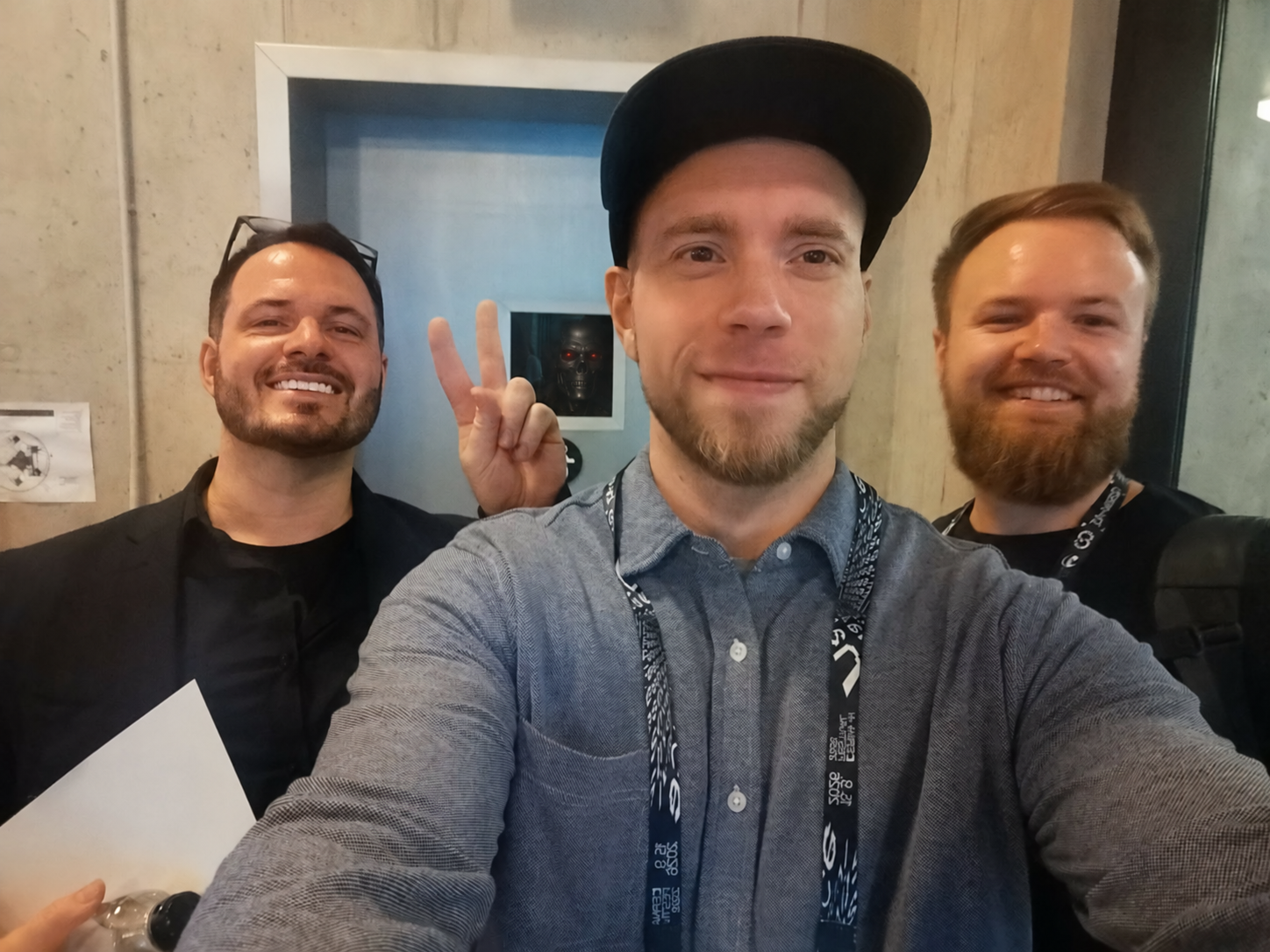
With Jakub Siwek and Filip Oborník. These meetings are also the reason why it makes sense to go to the festival in person.
Filip is a developer, AI lecturer and author of the educational project AI s rozumem. With Jindřich Dědek, he prepares Deeplink Show, where AI, technology and business are discussed from the perspective of development and products. Their interviews with Matěj Novák from IT4Innovations about supercomputers and with Dalibor Mráz about ČERNÁ.AI and the implementation of AI in practice are a nice link to the topic of this article. Filip also has his own podcast Coffee Break s Filipem. If you enjoy AI embedded in specific work and experiences, his work is worth exploring.
And I also thank those who looked after the real wolf for me. The one in the simulator can wait. The living one needs care even when his human is on stage explaining why twenty-five is not twenty-nine.
Ostrava, thanks. For the invitation, the encounters and the inspiration to keep experimenting. And the next time a model tells me "verified", I'd better see what it means.
Do you want to use LUMI for your own project?
Contact the Czech team LUMI AI Factory at IT4Innovations at ai-factory@it4i.cz. You can discuss your idea, the necessary computing power and support options with them. And if you want to connect with Jakub, here's Jakub Siwek on LinkedIn.