Alpha Industries enters the quantum era
For the first time, I sent a circuit to the real Czech VLQ quantum computer. The Bell state returned 94.2% correct outcomes and showed why it pays to approach a QPU with a hypothesis, a simulator and humility.

The cover visual is a generative-AI illustration, not a photograph of the real VLQ or the IT4Innovations facility. My female Czechoslovakian Wolfdog Raven symbolically guards the quantum lab.
This afternoon, I ran a computation on a real quantum computer for the first time in my life. The scheduled circuit itself took about a quarter of a millisecond, the complete remote job returned in roughly eight seconds, and its output was an unassuming column of numbers.
I was grinning like a child.
It was not a breakthrough calculation. It was a smoke test, the first check that I could authenticate, compile the circuit correctly, send it to physical hardware and understand the result. That is precisely why this apparently small moment matters: Alpha Industries has entered the quantum era.
Allocated time
10 QPU-h
for six months under EuroHPC project EU-26-106.
VLQ architecture
24 QB
superconducting qubits in a star around a central resonator.
First measurement
1,000
repetitions of a Bell state on physical hardware.
Correct signal
94.2%
of outcomes landed in the expected 00 or 11 states.
From Finland's LUMI to Czechia's VLQ
It began with the LUMI supercomputer in Kajaani, Finland. Through the European EuroHPC infrastructure I received 5,000 GPU-hours, which I have been using since July to study when several open language models are better than one giant model.
While looking through further European calls, I noticed that one could also apply for quantum systems. One of them was VLQ, the first quantum computer installed in Czechia, operated by the IT4Innovations National Supercomputing Center at VSB - Technical University of Ostrava.
So I applied.
The project is called Quantum-Assisted Panel Selection for Multi-Model AI Fusion. Approval arrived on 20 August: ten QPU-hours for six months. For a small Czech company this is a remarkable opportunity and an encouraging message to others: Europe's quantum infrastructure is not merely a showcase reserved for a handful of the largest laboratories.
The EuroHPC quantum access pilot is open to researchers, public institutions and industry, with free access awarded through peer-reviewed applications. It is designed for method testing, performance data collection, code and workflow development, and training.
Quantum as a service is no longer a futuristic metaphor. It is European infrastructure that can receive an ordinary Python program from your own computer.
What exactly is VLQ?
VLQ uses 24 superconducting qubits arranged in a star around a central computational resonator. IQM Quantum Computers supplied the system and IT4Innovations hosts and operates it. It is intended to connect with the classical Karolina and LUMI supercomputers for hybrid workflows.
The name carries a Czech trace: V refers to VSB, L to the LUMI-Q consortium and Q to quantum. Pronounced together, it resembles the Czech word vlk, meaning wolf, a relative of the Arctic wolf that represents LUMI.
The star topology matters to our experiment. Qubits do not interact directly as neighbours on a grid. Interactions pass through the central resonator, which changes circuit routing and where noise can accumulate.
A simulator before an expensive machine
I did not want to arrive at the QPU with a wish and start by trial and error. Before receiving access, I built VLQ Lab, a browser-based simulator for rehearsing circuits, qubit selection and the planned experimental campaign.
One useful input was the JiriTomcala/FakeVLQ repository, which contains three public calibration snapshots from March and May 2026 and code for constructing a fake backend. This third-party repository is extremely useful, but it lacks a detailed README and clear provenance for every dataset. I therefore treat it as a working model, not as an official current calibration from IT4Innovations.
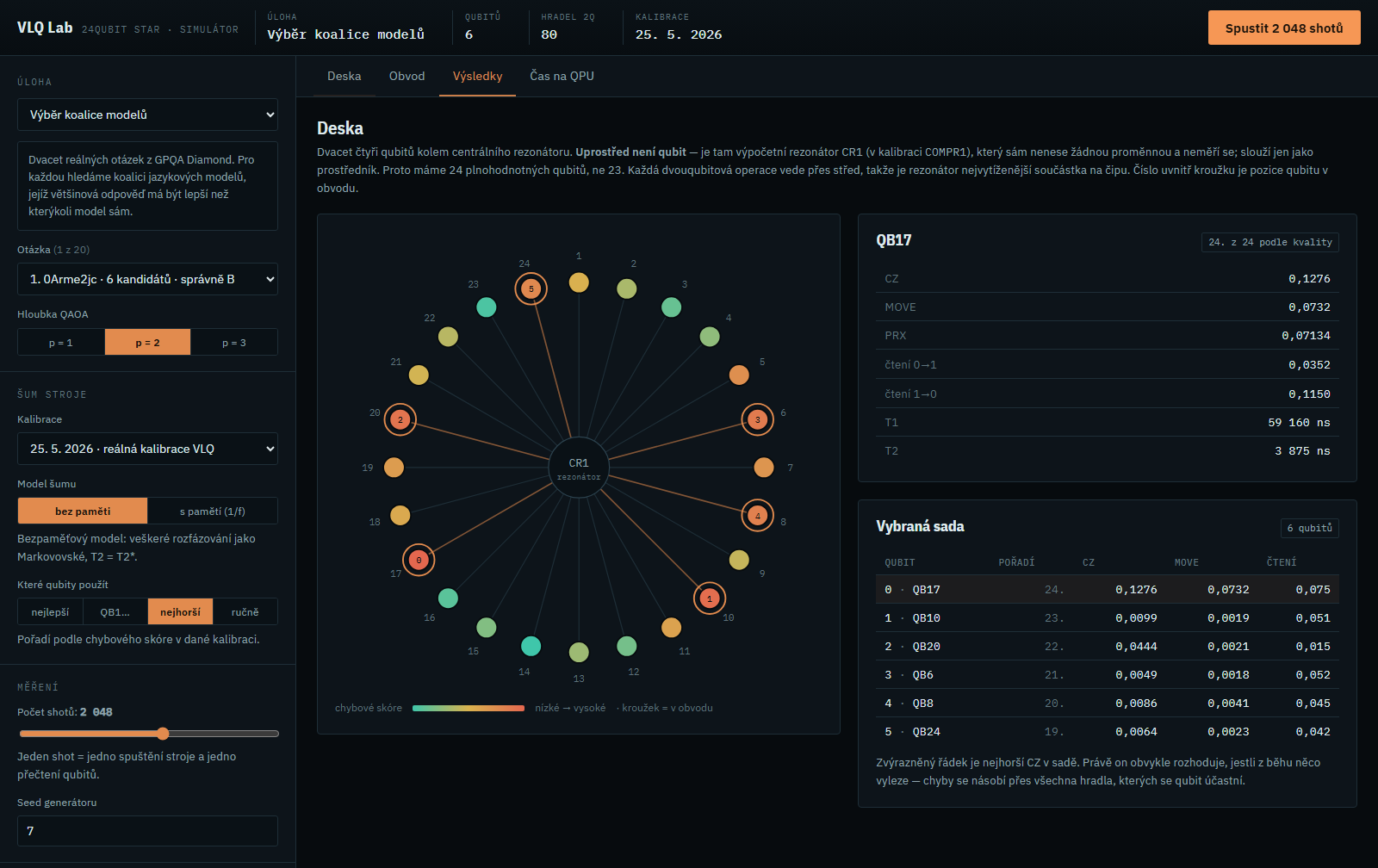
This preparation made it possible to register predictions in advance. We checked the QUBO-to-Ising mapping against exact enumeration, the QAOA implementation against Qiskit's simulator and noise sweeps against a realistic star-topology model. I therefore approached the machine with a falsifiable expectation, not merely the question “what might it do?”
Ten lines of Python to a real quantum computer
Much of the accessibility comes from IT4Innovations' open-source Quantum as a Service software. The qaas package handles authentication through LEXIS, allocation selection, circuit transpilation and result retrieval. In my environment, the first successful run was essentially this:
from py4lexis.session import LexisSession
from qaas.client import QProvider
from qiskit import QuantumCircuit

token = LexisSession().get_access_token()
backend = QProvider("EU-26-106", token).get_backend("VLQ-EU")

qc = QuantumCircuit(2, 2)
qc.h(0)
qc.cx(0, 1)
qc.measure([0, 1], [0, 1])

job = backend.run(backend.transpile(qc), shots=1000)
counts = job.result().get_counts()
There is a great deal of Czech engineering behind that simplicity. I did not need a direct connection to the cryostat, a proprietary language or manual queue management. I used Python and Qiskit, the same tools as on the simulator.
Along the way I found a bug in automatic resource detection and sent the team both a description and a proposed fix. Providing the backend's explicit name was a working workaround. This is what an open stack should enable: an external user runs something real, finds a sharp edge and returns an improvement to the community.
Why the first task was not “useful”
The first run was not intended to discover a material or solve a problem beyond classical computers. It had to verify the entire chain. Electronics engineers call this a smoke test: when a device is first powered on, the first question is whether it is alive and fundamentally behaving as expected.
I chose a Bell state, the simplest non-trivial test of two-qubit entanglement:
- Put the first qubit into superposition.
- Entangle it with the second using CNOT.
- Measure both one thousand times.
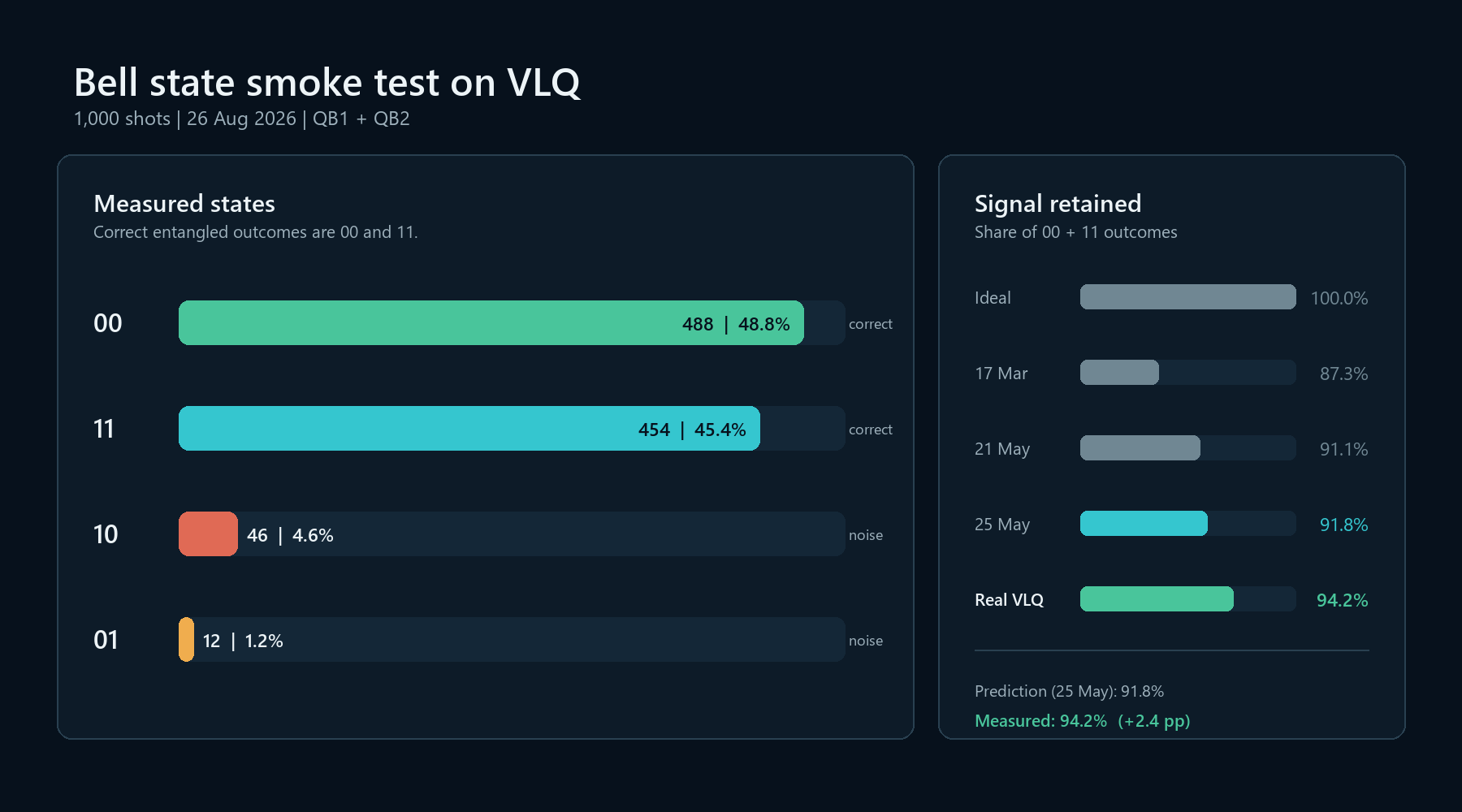
An ideal device returns roughly half 00 and half 11. The 01 and 10 states are errors. The expected answer is known in advance, so the experiment measures not what the computer discovered, but how faithfully it preserved the prepared state.
The result: 94.2 percent of the expected signal
| state | count | share | interpretation |
|---|---|---|---|
00 | 488 | 48.8% | correct |
11 | 454 | 45.4% | correct |
10 | 46 | 4.6% | noise |
01 | 12 | 1.2% | noise |
That yields 94.2% retained signal. The simulator based on the 25 May snapshot predicted 91.8%, so the real run was 2.4 percentage points better.
That is encouraging, but it does not prove that the machine improved by exactly 2.4 points after May. With 1,000 measurements, the approximate 95% interval around the observed share is plus or minus 1.5 percentage points, and the simulation has its own uncertainties. We are also comparing August hardware with a May calibration snapshot. The defensible conclusion is: the model was not overly optimistic, and the physical result is reasonably compatible with its expectation.
The asymmetry is more interesting than the total score
The erroneous states were uneven: 10 appeared 46 times, while 01 appeared only 12 times. The simulator had predicted them to be roughly symmetric across the older calibrations.
One working hypothesis involves the star architecture. During transpilation, one qubit may take a different route through the resonator and receive more MOVE operations than the other. Current readout errors, logical-to-physical mapping, correlated noise or a compilation detail could explain it just as well. One run cannot identify the cause. The next experiment will repeat the circuit on several pairs, swap their roles and compare the result with fresh calibration data.
This is precisely why a simulator is not enough. A model says what should happen given known errors. Hardware reveals which part of reality is still missing from the model.
A quantum chip is not a static table
The public calibration snapshots show substantial drift in individual qubits. In the composite score below, lower is better.
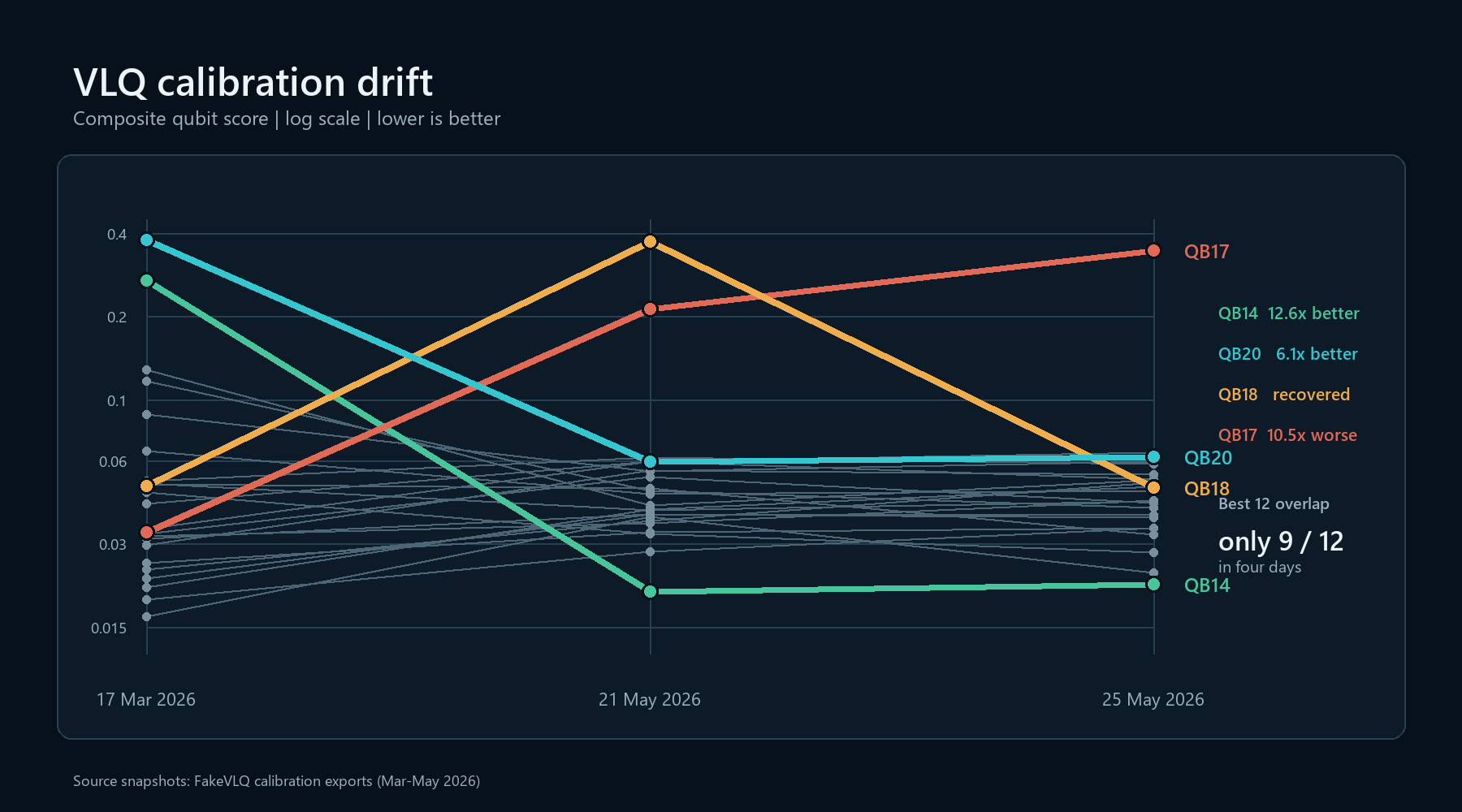
Between two snapshots only four days apart, the best twelve qubits overlapped in only nine positions. The practical implication is important: qubit selection cannot safely be prepared weeks in advance. It must use a fresh view of the device.
During the first session, the backend exposed 23 physical-qubit names and omitted QB3. This does not mean VLQ's official capacity changed from 24 to 23. It only means that the API offered 23 qubits at that moment. Code must nevertheless map by name rather than blindly assume that index 2 means QB3.
What we will actually study on VLQ
The Bell state was kilometre zero. The approved project addresses a practical question from our language-model fusion research: how to select a panel of models whose errors complement one another, quality remains high and inference cost stays reasonable.
With pairwise relationships between models, the task can be written as a QUBO and explored with QAOA, a hybrid quantum-classical algorithm. The plan has four stages:
- Small verifiable instances: twenty five-to-six-qubit problems checked against an exact classical solver.
- A twelve-model panel: measure how many shots are required to find the optimum with a chosen confidence.
- Scale to eighteen qubits: compare the full distribution with ideal and noisy simulation.
- Methodology: calibrate the noise model and compare default routing with our more economical MOVE schedule.
Up to eighteen models, LUMI can still compute the exact answer by brute force. That is an advantage, not a weakness. While learning when to trust the machine, we need tasks whose truth is known. Only then does it make sense to proceed to sizes where an exact classical result is no longer practical.
Czech teams have built accessible quantum infrastructure
Another part of this story makes me particularly happy: much of the path rests on Czech teams. IT4Innovations does not merely host and operate the first Czech quantum computer. It is also building documentation, support and an open software layer that makes remote use possible.
There were dead ends. This is new infrastructure and neither its documentation nor its client is flawless. What matters is that there were people behind it who responded, helped and wanted the sharp edges fixed. Special thanks go to the IT4Innovations team, Jakub Siwek and everyone around VLQ and QaaS who made first access a collaboration rather than an initiation rite.
Europe is doing the right thing here. Buying and displaying a quantum computer is not enough. Value begins when researchers, startups, companies and students can access it, make mistakes, measure and return their findings to the community.
How to request access
EuroHPC launched the quantum pilot in June 2026. Applications are submitted through the EuroHPC Access Platform and evaluated at regular cut-off dates. Czech research organisations can also use IT4Innovations grant calls; other LUMI-Q consortium countries provide national routes.
A good application does not need to promise a quantum revolution. Ours included:
- a specific problem and a reason simulation alone was insufficient,
- a working, validated local prototype,
- pre-registered hypotheses and measurable objectives,
- realistic estimates of jobs, shots and qubits,
- comparison against a known classical answer,
- a commitment to publish the pipeline, data and lessons learned.
Preparation matters more than company size. Quantum time is scarce, but the path to it can begin quite ordinarily: with a good question, Python and an honestly built simulator.
What we will give back
The project is not confidential. We plan to publish the pipeline, experimental protocols, analytical scripts and results progressively. The first day already produced a reproducible counts record, comparison with three simulated calibrations, a technical lessons log and a proposed client-library fix.
The greatest value of the first quantum run is not the number 94.2%. It is the moment when an abstract technology becomes a measurable engineering system to which we can pose a precise question.
We did not enter the quantum era by demonstrating quantum advantage. We entered it more soberly: we sent a circuit to a real Czech machine, obtained data, found a gap between model and hardware, and now know which experiment should follow.
That is exactly how science should begin.
Sources and acknowledgements
- IT4Innovations: VLQ quantum computer
- IT4Innovations: VLQ available to researchers and companies
- EuroHPC JU: opening the quantum access pilot
- IT4Innovations: Quantum as a Service
- JiriTomcala/FakeVLQ
- Qiskit
Project EU-26-106 on VLQ was supported through the EuroHPC JU quantum access pilot. LUMI experiments run under project EHPC-AIF-2026PG01-843. This work was supported by the Ministry of Education, Youth and Sports of the Czech Republic through the e-INFRA CZ (ID: 90254).