The European Commission has selected DigiHavel as one of the 14 best AI projects in education in Europe
Out of 209 European projects, the European Commission has shortlisted DigiHavel as one of 14 case studies of good practice in AI in education. The only representative from the Czech Republic — and already in second place in the DG EAC report. What does this mean and what are we planning next?
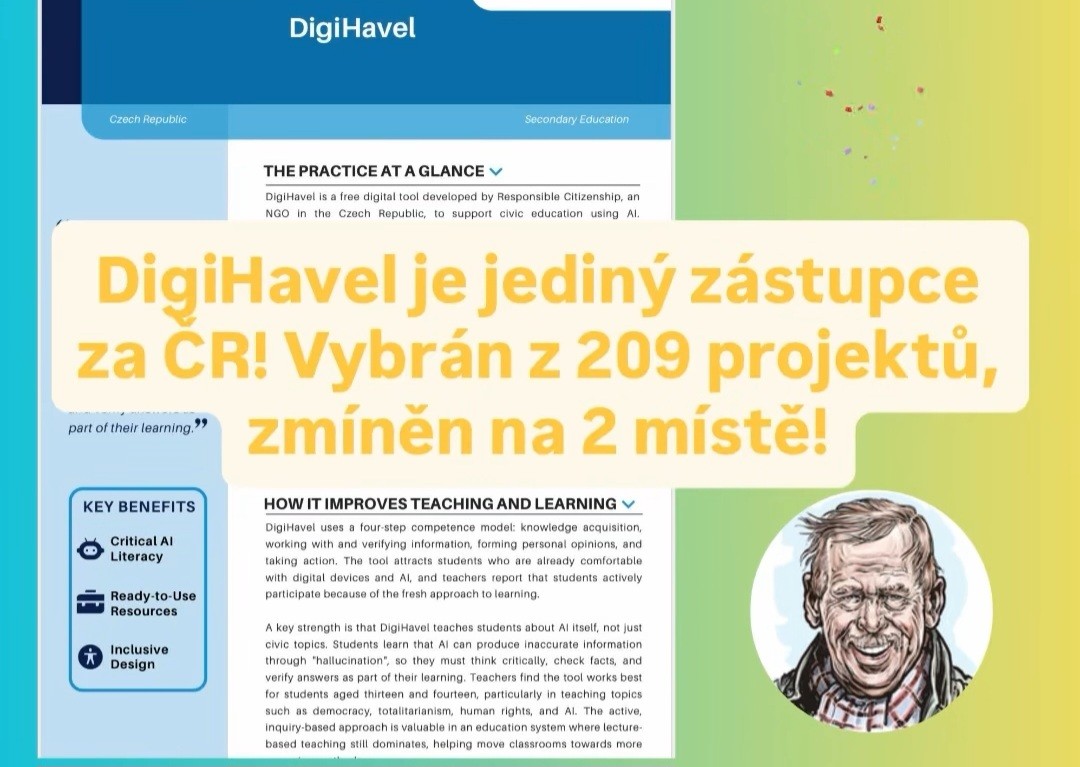
The European Commission has selected DigiHavel as one of the 14 best projects in AI education 🇪🇺
Out of a total of 209 projects across Europe, we have made it to the shortlist of case studies. DigiHavel is the only representative from the Czech Republic — and you can read about us in second place in the report from DG EAC.
DigiHavel is being developed in collaboration with:
- 👉 Alpha Industries — AI development and product architecture
- 👉 Responsible Citizenship + Konrad-Adenauer-Stiftung — pedagogical concept and dissemination
- 👉 Masaryk University, Faculty of Education — competency framework and methodology
We are immensely pleased that we are able to advance the teaching of democracy and critical thinking using AI at a European level. ❤️
What is this selection about?
This is a report titled “Good Practice in AI for Education: Spotlight on EU Case Studies and Insights”, commissioned by the Directorate-General for Education, Youth, Sport and Culture (DG EAC) of the European Commission — specifically Directorate C, Unit C4 for Digital Education. The authors are Stéphanie Créteur, Jekatyerina Dunajeva, Marta Lazaro Soler, and Hanna Siarova (PPMI / Budapest Corvinus University / ICF).
The aim of the mapping was to identify examples of ethical and responsible use of AI in education across the EU — something that can realistically be adopted in schools, not just a marketing demo.
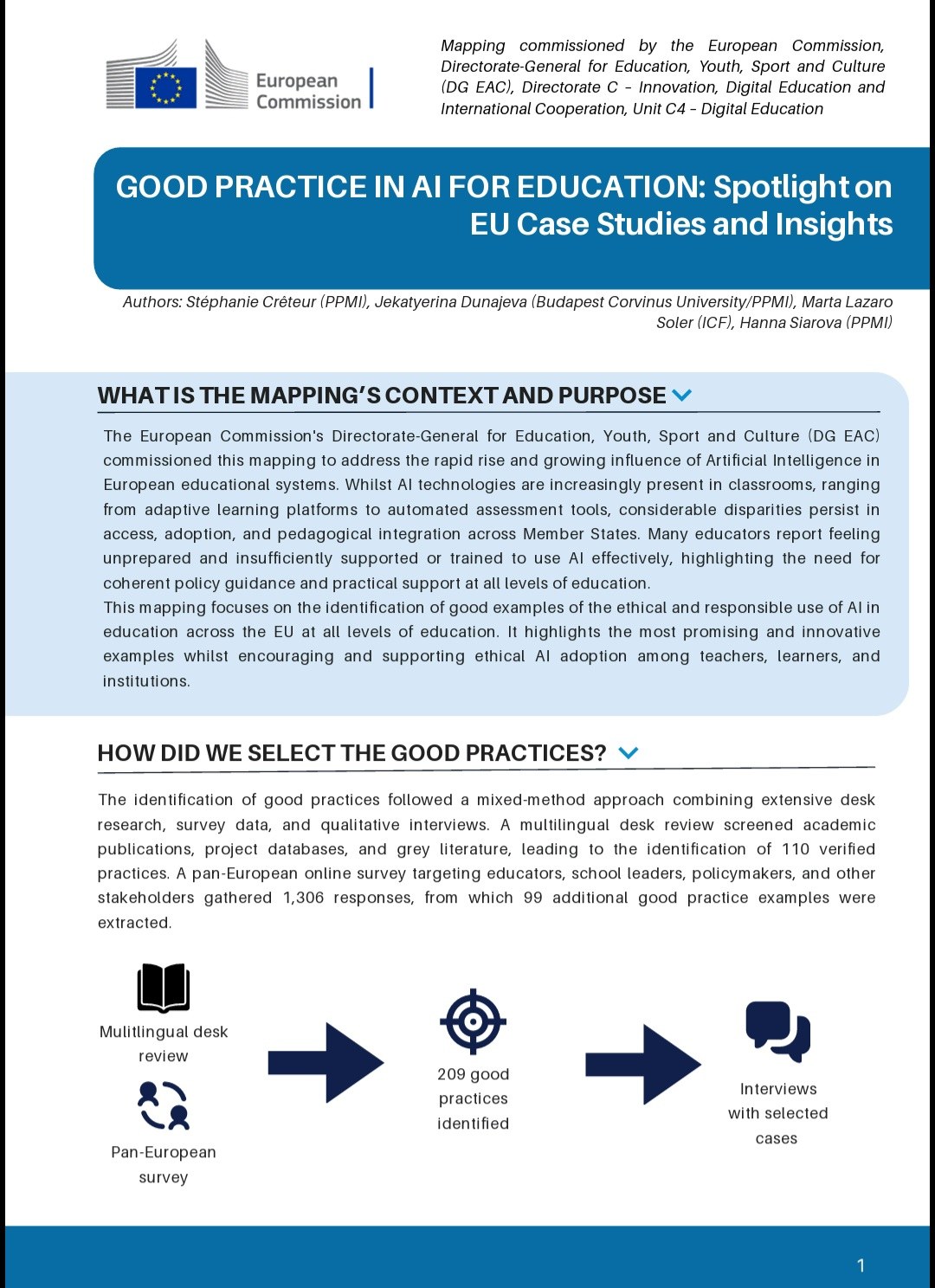
The process was rigorous and three-phased:
- Multilingual desk review of academic literature, project databases, and grey literature → 110 verified practices identified
- Pan-European online survey among educators, school leaders, policymakers, and others — 1,306 responses, with an additional 99 examples of good practice
- Interviews with selected case studies — resulting in 14 in-depth described projects
From the 209 identified projects, only 14 made it to the final shortlist. And among them is DigiHavel.
Why DigiHavel?
The report explicitly states what makes DigiHavel exceptional — and it is worth reading in the original, as it captures well what we have aimed for from the beginning:
“A key strength is that DigiHavel teaches students about AI itself, not just civic topics. Students learn that AI can produce inaccurate information through 'hallucination', so they must think critically, check facts, and verify answers as part of their learning."
In loose translation: a strong point of DigiHavel is that it teaches students about both AI and civic topics. Children learn that AI can hallucinate — and thus they must think critically, verify facts, and check answers themselves. Active questioning is noted in the report as a suitable way to shift classrooms from a lecture style to engaging students.
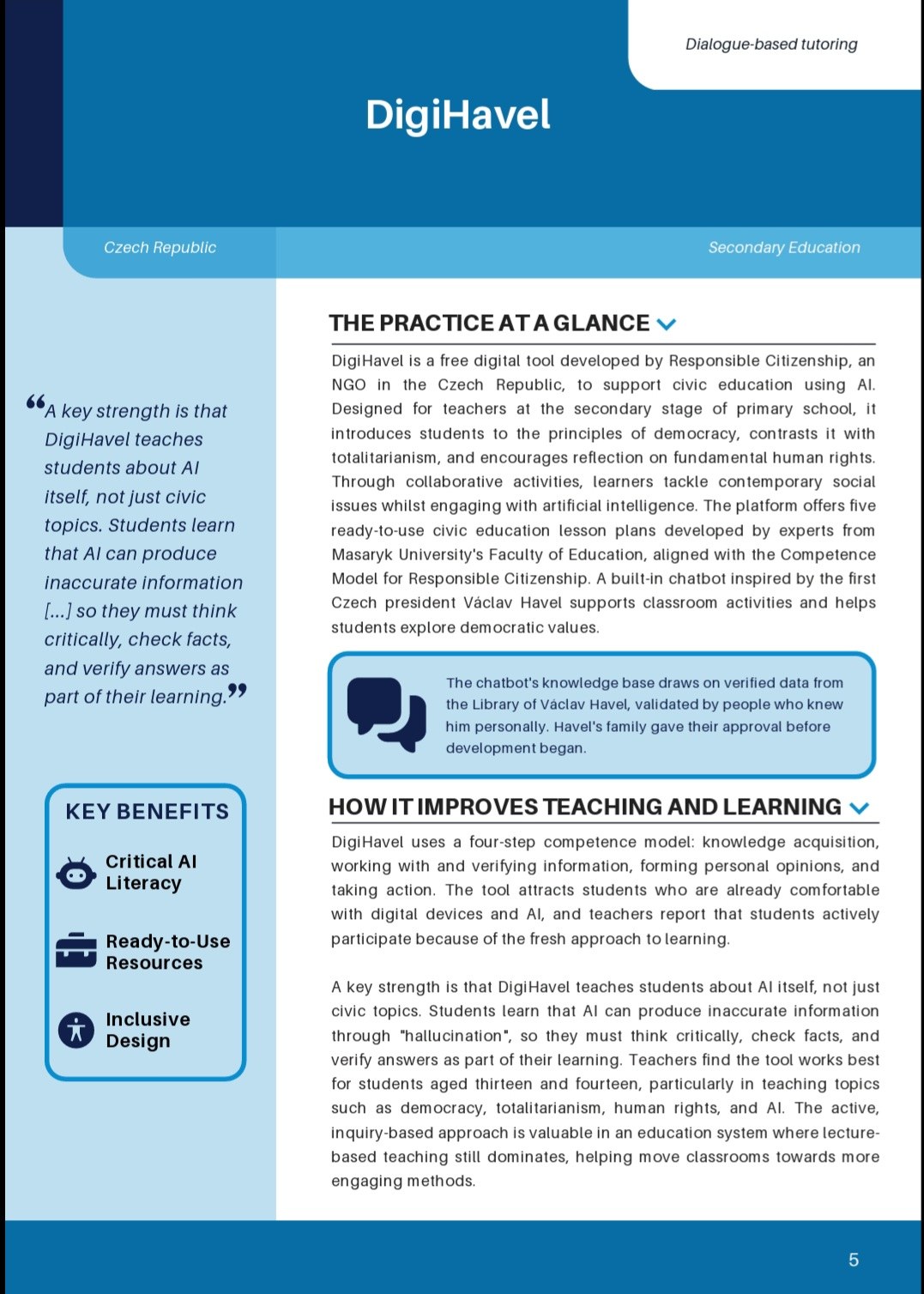
The Commission highlighted three key benefits:
- Critical AI Literacy — students experience on DigiHavel how AI thinks, where it makes mistakes, and why it cannot be blindly trusted
- Ready-to-Use Resources — five ready-made methodologies for civic education teachers, developed with the Faculty of Education at MU according to the Competency Model for Responsible Citizenship
- Inclusive Design — the chatbot is designed for students aged 13–14 regardless of prior digital skills
And one detail mentioned in the report that holds great value for us: the knowledge base of DigiHavel is built on verified data from the Václav Havel Library and validated by people who personally knew Havel. Before the development was launched, Havel's family also gave their consent. This meticulousness counts — without it, digital Havel would be just another imitation.
What does this mean for us
This is not just a compliment in a nice PDF. It is a signal for the entire EU that DigiHavel is a reference model of what AI in the teaching of democracy and critical thinking can look like — responsibly, ethically, and with real pedagogical depth.
And a signal for us: the conviction that it makes sense to push projects that do not promise an AI revolution, but quietly and diligently advance how children think.
If you are interested in such projects
We are already preparing something big — the next generation of digital tools for education, international expansion of DigiHavel, and new formats where AI does not replace the teacher but becomes a partner in learning.
If you teach at a school, coordinate an educational project, work in a non-profit, or at a ministry — get in touch with me. I would be happy to show you how to implement DigiHavel in your setting and listen to what you might need additionally.
Thank you to everyone involved in DigiHavel — without the Faculty of Education at MU, Responsible Citizenship, KAS, and the Václav Havel Library, we would not have gotten anywhere. This is a shared success.