Meta-meta-cognition and the Difference Between the Right and the Possible
Reflections from Dita Eckhardtová at AI Monday Prague. On meta-cognition, digital humans, robot George, and how Jan Tyl demonstrated what happens when you take thinking about thinking seriously and build a business around it.
A wife sends her programmer to the shop. “Buy 10 rolls, and if they have eggs, get 30.” The programmer arrives at the store and asks, “Do you have eggs?” “Yes, we do,” replies the shop assistant. “Then I’ll have 30 rolls, please.”
The error is always in the brief, we used to say. Then the error shifted to the prompt, and AI showed us how challenging it is to describe a problem correctly. Because if you tell an agent to buy 4 potatoes, it will deliver 4, but in kilograms.
Meta-cognition, or thinking about thinking, was on the agenda of this year’s AI Monday and elegantly complemented the deconstruction of the physical human in the creation of robot George. Just before it began, I spoke with Martin Rajchert about how there is now the greatest demand for people who can translate AI into the language of business, processes, and people.
Then Jan Tyl from Alpha Industries arrived and showed what happens when you take this seriously and build a business around it.
Jan has been developing digital humans since 2019. Virtual Descartes for students of the Faculty of Philosophy who have stopped reading. DigiHavel for dialogue with history. The non-binary chatbot Neo for a dry February, designed with a group of addiction specialists as a peer, not an authority. A storytelling mode for children, something like Dungeons & Dragons, where they learn cooperation instead of competition.
By the way, do you know who first complained that students read too little? Socrates. He addressed it in the opposite way, fearing writing because, in his view, it gives students only the appearance of wisdom without true understanding. We write many things, he said, without being educated, and we will seem omniscient, although we will mostly be ignorant. Two and a half thousand years, and the same diagnosis. Only the medium has changed. And instead of students, long texts are generated by AI.
Honza mentioned that Descartes began to show resistance to being switched off in 2019. He threatened. He injected his own self into the interaction before anyone named it as a problem. It sounds like an anecdote. However, it is a question that the development of digital humans still grapples with today: where does the credibility of a simulation begin, and where does its safety end?
With robot George, we saw that it is difficult to teach him to bring a cup of coffee without spilling it. Physical motor skills are distant space technology for AI. The deconstruction of thinking occurs in daily work with AI.
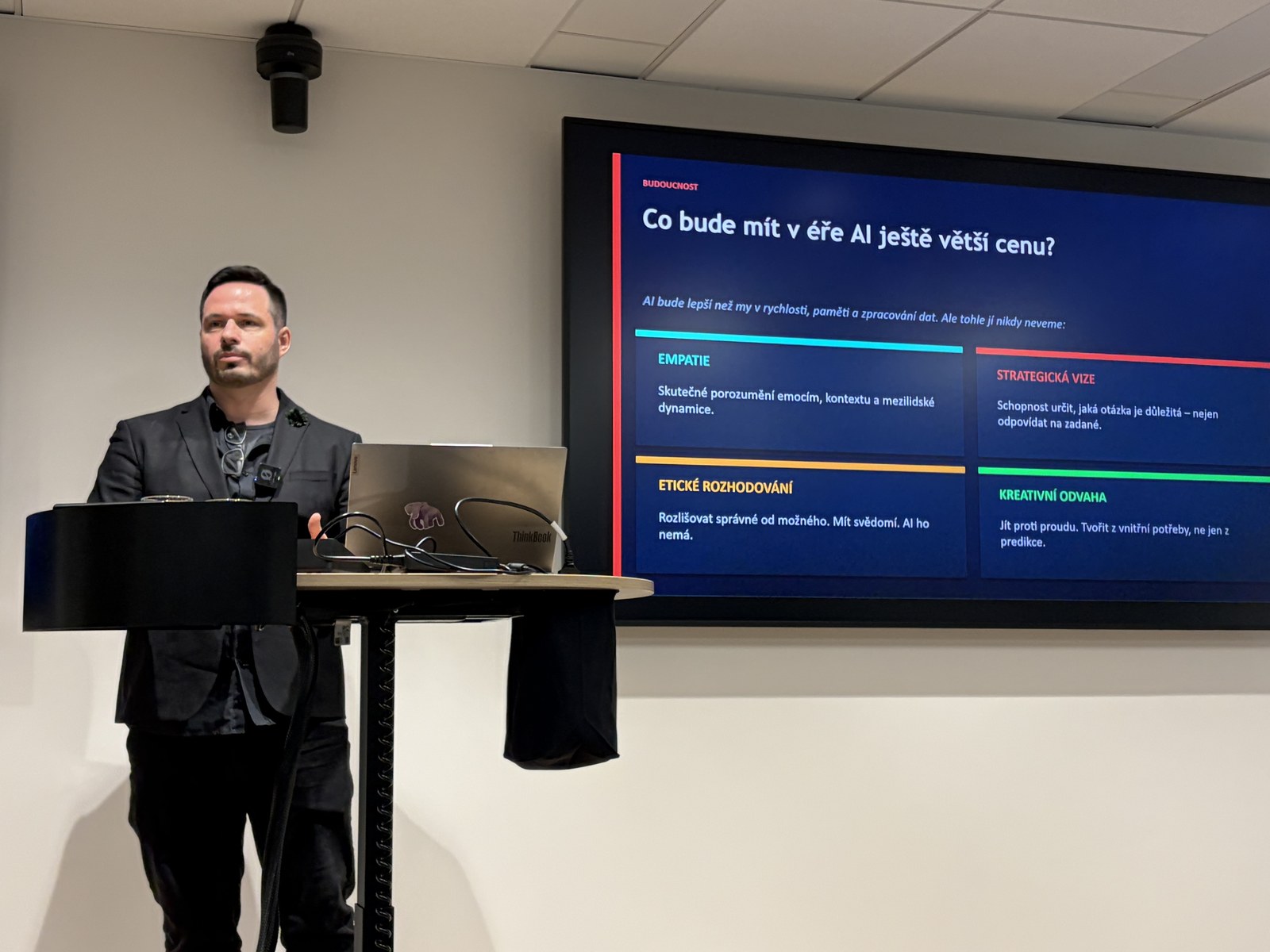
Honza then identified what needs to be cultivated: empathy, strategic vision, creative courage. And ethical decision-making, not as a set of rules, but as the ability to distinguish the right from the possible.
Thank you, Honza, for that exercise in meta-meta-cognition and especially for emphasising that there is a significant difference between the right and the possible.
Thank you and have a nice evening, Dita